
The Control Plane Outside the Agent
Why Autonomous Systems Need Independent Custody of Processes, Budgets, Recovery, and Real-World Action
This research informs the hands-on architecture and implementation work Cognilode delivers for engineering teams.

An autonomous system can be capable enough to write code, operate a browser, call tools, coordinate other agents, and continue working for hours without direct supervision.
That does not make it a reliable custodian of the process, credentials, budget, and machine that make those actions possible.
The more authority an autonomous system receives, the more important it becomes to place part of the architecture outside its own reasoning loop. That outside layer decides whether work may start, owns the processes and runtime identities, watches resource pressure, scopes privileged operations, preserves recovery points, and gives operators a dependable path to stop or restore the system.
We call that layer the external control plane.
Its purpose is not to make autonomy timid. Its purpose is to make autonomy operable, recoverable, and fast enough to be useful.
Autonomy Needs an Outside
A typical agent architecture concentrates nearly everything inside one loop:
receive objective
→ assemble context
→ reason
→ call tools
→ inspect results
→ continue or stop
That loop may be sophisticated. It may use planning, memory, specialized workers, tool policies, and model-based self-critique. But it still shares one fundamental limitation: when the loop is confused, stale, unavailable, or itself part of the failure, it cannot be the only mechanism responsible for recovering the system.
An outside control plane owns a different class of facts:
- which process and process group belong to the run;
- which workspace, temporary directories, sockets, and model state belong to it;
- which binary and runtime configuration launched it;
- how much model quota, CPU, memory, storage, or GPU capacity it may consume;
- whether the environment is healthy and fresh enough to accept more work;
- which privileged network or host operations are available;
- which snapshot and durable-data generation correspond to the run’s starting point;
- how to stop, isolate, restore, or restart the system coherently;
- which action receipts and artifacts prove what actually occurred.
The autonomous system can request an action. The control plane owns the mechanical reality in which that action occurs.

This is not the same as adding a second model to supervise the first. Model-based supervision is valuable for interpreting strategy, quality, and progress. Mechanical custody solves a different problem.
A supervisory model may recommend that a run stop. The control plane must know which process group to terminate. A model may recommend rollback. The control plane must know which code snapshot, database generation, runtime binary, and service state belong together. A model may report that the system is healthy. The control plane must still verify that health information is fresh, that required services are available, and that no hard stop is engaged.
The two layers complement each other:
semantic supervision
  interprets quality, progress, and strategy

mechanical custody
  owns processes, resources, runtime state, and recovery
Four Generations of Control Architecture
Across several generations of our autonomous-system infrastructure, the outside layer evolved from a small supervisor into a complete runtime-custody architecture.
1. Isolated workspaces and external restart policy
The smallest useful control plane was a supervisor that read a queue of goals, created a fresh Git branch and worktree, launched autonomous code work in the isolated checkout, recorded the child process, and restarted later cycles with backoff.
That compact design established several principles that remain valuable:
- autonomous changes should not begin in the operator’s primary checkout;
- resource posture should be set at launch, not left as a prompt reminder;
- restart policy should live outside the worker being restarted;
- even a minimal PID and log create an external observation surface.
We used this pattern to let autonomous code work proceed in dedicated branches while keeping the operator’s working tree undisturbed and the resulting changes inspectable.
2. A privileged hub for networked workers
As the architecture expanded to several workers, the control boundary moved into a hub.
Workers could reason locally and submit structured requests, patches, messages, or control actions. The hub retained privileged capabilities such as repository mutation, authenticated service access, and management operations. Requests could be checked against the caller’s identity, role in the hierarchy, target, and allowed capability before the mutation occurred.
This pattern is especially useful in multi-agent systems:
worker proposes change
→ hub checks identity and scope
→ hub performs privileged mutation
→ durable receipt returns to worker
It allowed workers to remain productive without distributing every credential and privileged tool to every runtime. It also gave the system one place to record who requested the action, what target was affected, and what result returned.
3. A separate trust domain
The next step was architectural rather than incremental: the controller moved outside the mutable system it supervised.
The control plane gained its own repository, service, configuration, runtime state, credentials, and recovery path. The target remained free to evolve rapidly, while the outside layer retained a stable route for observation, process control, resource response, snapshotting, quota management, and recovery.
This separation is crucial for self-modifying or frequently updated systems. If the recovery mechanism imports the same code that just became unavailable, or relies on the same state store the target has corrupted, it is not an independent recovery mechanism.
The outside controller instead treated the live system as a target with observable processes, filesystems, services, and artifacts.
4. Runtime reality custody
The mature design extended custody beyond “which process is running?” into the full reality of a run:
- workspace identity;
- runtime namespace;
- process and process-group ownership;
- temporary and state directories;
- tool and application sockets;
- model home and binary provenance;
- resource and quota budget;
- snapshot and durable-data baseline;
- external-action scope;
- result artifacts and action receipts;
- cleanup and rollback ownership.

The Runtime Reality Envelope
A useful way to design the control plane is to draw a reality envelope around each autonomous run.
At the center is the work itself: the objective, context, model, tools, and domain logic. The farther outward we move, the more the concern belongs to mechanical custody rather than reasoning.
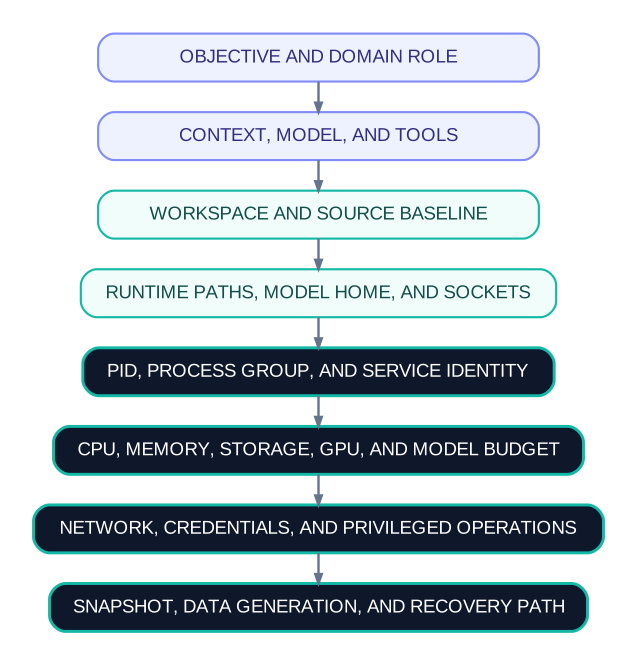
Workspace identity
For code work, a dedicated Git worktree or cloned workspace gives each run an inspectable source baseline and an isolated destination for changes. For other workloads, the equivalent may be a database branch, object-store prefix, browser profile, document workspace, or workflow namespace.
The important property is ownership: the system knows which reality belongs to the run and can compare, retain, promote, or remove it later.
Runtime namespaces
We used lightweight runtime namespaces to give concurrent workers separate temporary roots, model homes, sockets, state directories, and process identity. This prevented accidental collisions while preserving fast startup.
The same pattern can be implemented at several strengths:
- path and environment namespaces for cooperative workloads;
- containers for stronger filesystem and process separation;
- virtual machines or separate hosts for adversarial or high-impact workloads;
- Kubernetes namespaces and workload identities for distributed platforms.
The correct choice depends on threat model and blast radius. The architectural contract remains the same: a run receives an owned runtime identity that the control plane can observe and clean up.
Process groups, not isolated PIDs
Autonomous work often launches children: test runners, browsers, compilers, model servers, shell commands, and helper processes. Recording only the parent PID is not enough.
Launching the run in its own operating-system session and recording the process group gives the controller a much stronger ownership primitive. Stop and cleanup operations can target the entire tree of work rather than leaving descendants behind.
Binary and runtime provenance
When several builds or model-runtime versions exist, the control plane should record which executable actually ran. This becomes essential when diagnosing behavioral differences, reproducing a result, or restoring a known-good environment.
A durable launch record can include:
run identity
workspace baseline
runtime recipe
selected executable and provenance
PID and process group
model configuration
resource budget
snapshot baseline
output artifact locations
Process Alive Is Not Work Alive
One of the most important operational distinctions is the difference between liveness and meaningful progress.
A PID can exist while a process is blocked. A process can emit logs while repeating the same work. A model can consume tokens without advancing the objective. A backend task can complete while its result remains undelivered.
We therefore treat health as a ladder rather than one boolean:
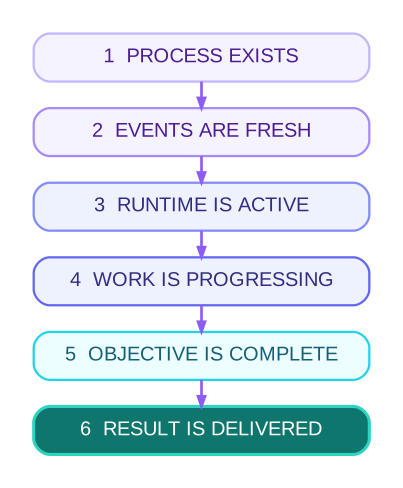
A production control plane can combine several signals:
- process and process-group state;
- timestamped heartbeats;
- event-stream freshness;
- current phase or activity class;
- output or artifact growth;
- resource consumption;
- terminal events;
- explicit hard-stop state;
- delivery or downstream acknowledgement.
This supports a much better admission rule for new work. Instead of asking only whether a service is running, the system can ask:
- Is the control plane itself fresh?
- Are required lanes enabled and healthy?
- Is any hard stop engaged?
- Is the host under pressure?
- Is the previous work still active or awaiting delivery?
- Is the runtime ready to accept another objective?
We used this kind of semantic health as an admission condition for launch and restart, with operator-facing descriptions that explained the current state rather than exposing a bare color or PID.
Resource Stewardship as a Closed Operational Loop
Long-running autonomous systems create a distinctive resource profile. They may compile code, run browsers, keep model processes warm, accumulate logs, create snapshots, open temporary workspaces, or launch several parallel trials.
A useful resource steward does more than emit alerts. It performs a closed loop:
observe pressure
→ classify cause
→ select bounded action
→ record what happened
→ re-observe the host
→ continue, escalate, or stand down
In live operation, we used pressure-aware resource management to keep the actions proportional to the cause:
- temporary-storage pressure triggered temporary-storage cleanup;
- home or high-capacity-volume pressure allowed heavier reclamation appropriate to those locations;
- logs were bounded so the monitor did not become a new source of unbounded growth;
- snapshot previews were time-bounded and failed softly;
- expensive or low-value cleanup lanes remained disabled unless their underlying infrastructure was actively in use;
- remediation was constrained by age, contribution, cooldown, and maximum-actions-per-window policies.
This kind of stewardship is especially important around model-driven workloads because not every resource-heavy process is an offender. A compiler may be legitimately active. A browser may be holding an authenticated session required by the task. A model server may use memory while remaining useful.
The control plane should therefore classify contributors rather than indiscriminately killing the largest process. Process age, recent CPU share, memory use, role, target ownership, and current host pressure can all participate in the decision.
The result is an operational loop that remains useful over time: bounded, inspectable, and tuned to the actual environment.
Privileged Actions Through a Narrow Waist
Distributed autonomous systems should not distribute every privileged credential to every worker.
A cleaner architecture places privileged mutations behind a narrow hub or control service. Workers can still operate independently: they inspect data, create patches, prepare messages, and propose actions. The privileged boundary performs the mutation and returns a receipt.
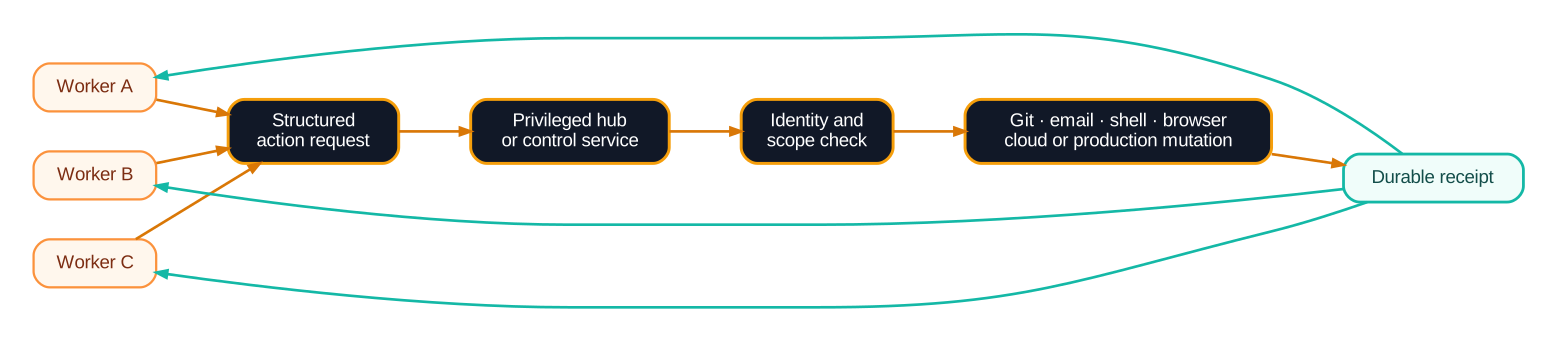
The action contract should include enough information to make the result attributable and idempotent:
- caller identity;
- target identity;
- requested operation;
- scope and constraints;
- idempotency key where duplicate execution would be harmful;
- credential or authority class used;
- execution timestamp;
- provider or system receipt;
- observed resulting state.
This is not a requirement that every useful action wait for a human. It is a separation of concerns. Domain policy decides whether the action should occur. The control plane ensures that the mechanically privileged path is narrow, attributable, and operable.
Recovery Is a Transaction, Not a Branch Reset
Git is an excellent source-control system. It is not a complete recovery system for an autonomous runtime.
A run may change several realities independently:
- repository files;
- a SQLite or Postgres database;
- browser or application state;
- selected model or runtime binaries;
- queues and leases;
- temporary workspaces;
- service configuration;
- active process trees;
- external systems.
A reliable rollback must know which of these belong together.
We linked launches to kickoff snapshots and eligible rollback candidates, then treated recovery as a composed transaction:

A strong snapshot record can preserve:
- source baseline or release set;
- a consistent database backup;
- selected runtime binary;
- configuration and policy generations;
- artifact references;
- integrity hashes;
- retention and free-space policy;
- the run or work intent associated with the snapshot.
This creates a powerful relationship between recovery and speed. When an autonomous system works in owned environments and recovery points are explicit, it can attempt broader changes with less operator fear. Reversibility is not merely a safety property. It is an enabler of ambition.
Calibrating Friction by Impact and Reversibility
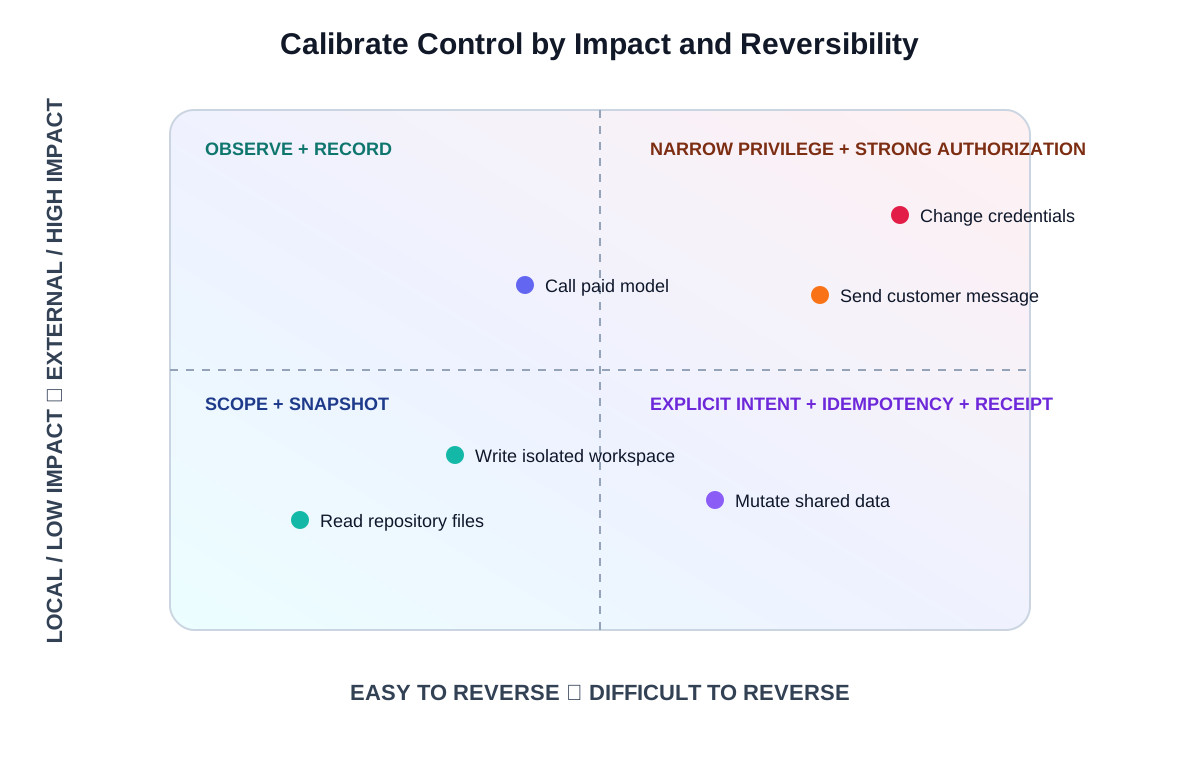
Controls can be too weak. They can also be too broad.
The most useful architecture separates mechanical custody from business judgment.
The control plane is well suited to questions such as:
- Who requested this action?
- Which credential or privileged path performed it?
- What target was affected?
- Was the action already executed?
- What receipt returned?
- Can the local part of the change be reversed?
A product, business, or organizational decision system is better suited to questions such as:
- Is this message appropriate for the customer?
- Is this purchase commercially justified?
- Should this application be submitted?
- Does this action advance the objective?
We use a proportional ladder rather than one global approval mechanism:
observe
→ warn
→ pace or quota
→ isolate
→ require explicit intent
→ scope credentials or network
→ require domain authorization
→ block
The correct rung depends on two dimensions: impact and reversibility.
| Action | Impact and reversibility | Typical control |
|---|---|---|
| Read repository files | Local and reversible | Observe |
| Write an isolated workspace | Local and easily discarded | Record baseline and scope |
| Run tests or compilers | Resource-consuming but contained | Budget and process custody |
| Call a paid model | Financially bounded | Attribute and pace |
| Modify shared durable data | Broader local impact | Transaction, backup, and explicit intent |
| Send a customer message | External and difficult to retract | Identity, domain authorization, idempotency, receipt |
| Change credentials or production access | High-impact and hard to reverse | Narrow privilege and strong authorization |
The objective is reversible autonomy: allow the system to move quickly where actions are contained and recoverable, while increasing friction as impact rises and reversibility falls.
Where This Architecture Proved Useful
The control-plane pattern became valuable across several different kinds of autonomous work.
Isolated autonomous software changes
For code evolution, dedicated branches and worktrees let autonomous runs inspect, modify, and validate a repository without disturbing the operator’s primary checkout. Launch-time resource posture and externally owned restart policy made the run reproducible, while the resulting branch and logs remained easy to inspect.
This created a clean promotion path:
known source baseline
→ isolated autonomous change
→ tests and produced artifacts
→ reviewable branch or patch
→ deliberate integration
Networked workers with centralized privilege
In distributed worker networks, we centralized authenticated and privileged mutations while leaving investigation and implementation work distributed. Workers could prepare patches, requests, and management actions; the hub performed the privileged operation and returned a durable result.
That preserved a useful balance: many workers could operate concurrently without requiring every worker to hold repository-hosting credentials, privileged shell access, or direct authority over every other runtime.
Live host stewardship
For long-running workloads, we operated a host-management loop that classified storage, CPU, memory, GPU, and process pressure, then selected bounded actions appropriate to the observed cause. The loop retained operator-readable status, bounded its own logs, respected cooldowns and action limits, and could use model-assisted triage without making the model the only path to recovery.
The practical effect was a host that could continue supporting long-running autonomous work while keeping resource pressure visible and manageable.
Parallel trials with owned runtime identity
For comparative trials, each variant could receive its own workspace, temporary root, model home, sockets, process group, quota allowance, and result artifacts. A heartbeat exposed current trial state, while launch records linked the variant to its baseline and recovery candidate.
This made parallel experimentation more meaningful: variants differed in the intended model, context, or runtime policy rather than accidentally sharing hidden mutable state.
Five Classes of Control-Plane State
Control systems often become difficult to maintain because logs, dashboards, configuration, checkpoints, and artifacts slowly become competing sources of truth.
A cleaner architecture separates five state classes.
Declarative specifications
Versioned descriptions of runtime recipes, policies, worker identities, resource thresholds, and data classes.
Operational records
Runs, commands, facts, action requests, receipts, outcomes, process registrations, cursors, and current custody state.
Immutable artifacts
Logs admitted for durable use, model outputs, patches, screenshots, generated files, media, and other content-addressed results.
Disposable projections
Dashboards, Markdown reports, current-status JSON, aggregate metrics, and search indexes that can be regenerated from durable facts.
Checkpoints
Snapshot manifests, schema versions, release sets, policy generations, artifact references, and integrity hashes required to restore a coherent reality.
specifications define what should exist
operational records describe what happened
immutable artifacts preserve the produced content
projections explain the current state
checkpoints make recovery reproducible
This classification keeps a dashboard from quietly becoming the authoritative database and prevents current status from being inferred from an old file whose writer stopped hours ago.
On a single host, the operational ledger may be SQLite. In a distributed platform, it may be Postgres, a durable workflow engine, or Kubernetes custom resources. The backend is less important than the ownership rule: one clearly owned transactional record for mechanical custody, with generated views treated as disposable.
Use Mature Infrastructure for Commodity Mechanics
The outside control plane should not become an excuse to rebuild every systems primitive.
We use established infrastructure where it fits:
- systemd or supervisord for service and process supervision;
- Git worktrees or cloned workspaces for source isolation;
- containers, virtual machines, or Kubernetes when stronger runtime isolation is needed;
- Btrfs or other snapshot-capable storage for fast filesystem checkpoints;
- SQLite, Postgres, or durable workflow engines for operational records;
- OpenTelemetry-compatible events and traces for interoperable observation;
- mature queues and schedulers for delivery and retry semantics.
Custom code should focus on the contracts unique to autonomous systems:
- what constitutes semantic health;
- which runtime identity belongs to a run;
- which resources and privileged operations are in scope;
- which snapshot is eligible for rollback;
- which artifact or receipt proves an action occurred;
- how a trial variant is admitted and cleaned up;
- how the operator sees and controls the current reality.
This division keeps the control plane small enough to trust while still giving it the domain knowledge needed to operate autonomous work correctly.
A Production Pattern for Recoverable Autonomy
The mature architecture can be summarized in five layers:
Autonomous workers and domain systems
  plan, reason, use tools, produce changes, request actions
        ↓
Independent runtime control plane
  admits work, owns processes, namespaces, resources, snapshots, and receipts
        ↓
Execution substrate
  operating-system processes, containers, browsers, repositories, and services
        ↓
Durable operational ledger and immutable artifacts
  record what occurred and preserve what was produced
        ↓
Operator surface
  status, watch, stop, continue, isolate, and restore
The agent remains responsible for intelligence. The domain system remains responsible for meaning and business value. The outside control plane remains responsible for keeping the runtime reality coherent.
That separation applies across many kinds of autonomous systems:
- coding agents making broad repository changes;
- browser and computer-use systems acting in authenticated applications;
- long-running research and operations agents;
- multi-agent networks that need shared privileged services;
- autonomous content and media workflows;
- business systems that send messages, update customer state, or create deliverables;
- internal AI platforms that need cost, recovery, and operator control.
The Goal Is Not Less Autonomy. It Is Recoverable Autonomy.
The central operational paradox is that greater autonomy requires a stronger outside boundary.
Not because the agent should be prevented from acting—but because consequential action needs a runtime that remains understandable and recoverable even when the agent is not.
When workspaces are isolated, process ownership is explicit, resource pressure is observable, privileged actions are narrow and attributable, and rollback can restore a coherent reality, autonomous systems can attempt more ambitious work with less operational risk.
The control plane is what lets the agent move quickly without becoming the only thing capable of stopping itself.
About Cognilode
Cognilode designs and implements advanced infrastructure for autonomous and agentic systems. Our work spans long-running runtime operation, retrieval and memory, multi-agent coordination, computer use, evaluation, cost attribution, isolated experimentation, recovery, and production integration.
For teams moving from agent demos to dependable autonomous products, the control plane should be treated as core architecture—not as an operational afterthought.
Operate autonomous systems with independent control and coherent recovery.
Cognilode can review process custody, budgets, external-action authority, semantic health, runtime isolation, and rollback—then implement the missing control-plane layers.
Related engineering notes
Why Agent Traces Are Not Enough
A practical architecture for observing what autonomous systems saw, decided, delegated, spent, changed, and delivered—not merely which API calls completed.
Read article →
The Data Architecture of Long-Running AI Agents
A practical architecture for separating runtime events, durable memory, business state, derived context, and recoverable data in long-running autonomous systems.
Read article →