
Why Agent Traces Are Not Enough
The Architecture of Observability for Autonomous Systems
This research informs the hands-on architecture and implementation work Cognilode delivers for engineering teams.
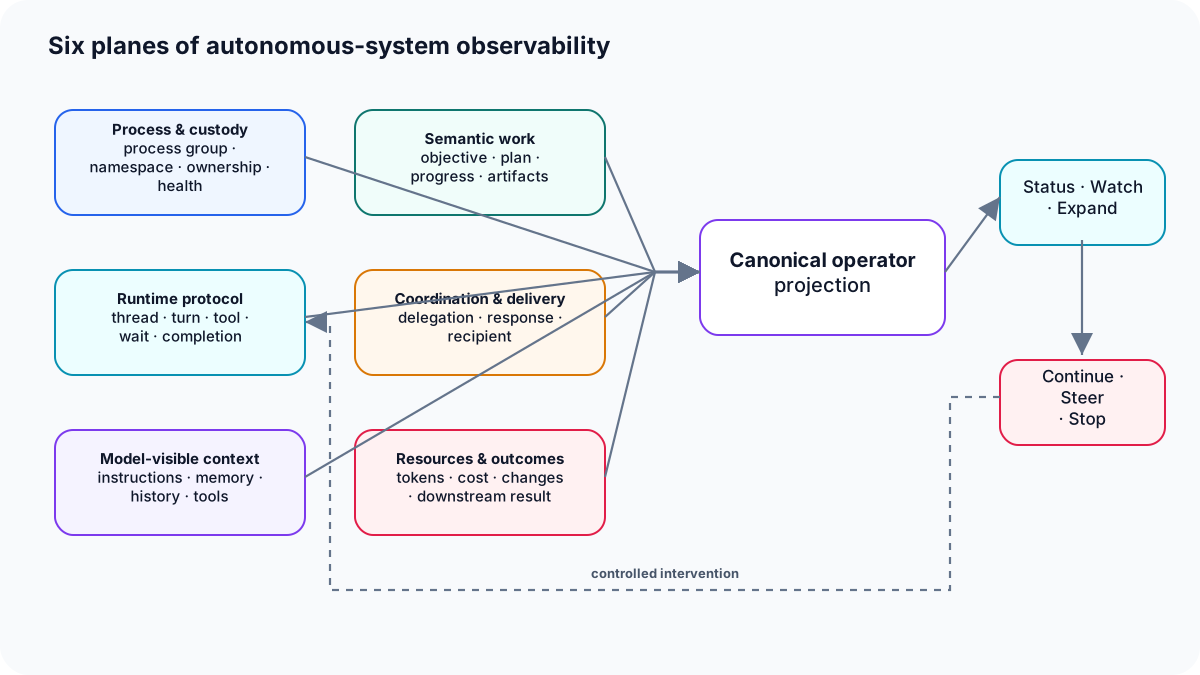
Observing what autonomous systems saw, decided, delegated, spent, changed, and delivered.
A dashboard shows that a model call completed, several tools ran, and a large number of tokens were consumed. The worker process is still alive. The trace is green.
Yet the operator still needs to know:
- What did the model actually see?
- Which objective was active?
- Did the work advance, or did the runtime merely remain busy?
- What was delegated to another worker?
- Which files, artifacts, messages, or external systems changed?
- What did the run cost, and which phase consumed it?
- Did the result reach the person or system that needed it?
- Can the operator safely continue, steer, or stop the work?
These are not edge questions. They are the central operating questions of autonomous systems.
Traditional tracing is indispensable. Spans, logs, tool-call records, token counts, and latency measurements reveal how software executed. But autonomous work spans a wider reality: operating-system processes, model-visible context, evolving plans, delegated threads, persistent artifacts, human interventions, and downstream delivery.
The architecture we have found most useful treats traces as one input to a broader operational model of autonomous work.
A trace shows what ran. An operator needs to understand what happened.
From Tracing to Operational Understanding
A production autonomous system should be observable across six distinct planes:
- Process and custody — what is running, who owns it, and how it can be controlled.
- Runtime protocol — which turn, tool, delegation, wait, or terminal transition is active.
- Model-visible context — the exact instructions, memory, history, environment, and tools visible to the model.
- Semantic work — the objective, current plan, meaningful progress, and artifacts being produced.
- Coordination and delivery — who delegated work, where results returned, and whether they reached their destination.
- Resources and outcomes — tokens, context occupancy, cost, produced changes, and downstream effects.
An operator-control loop crosses all six.
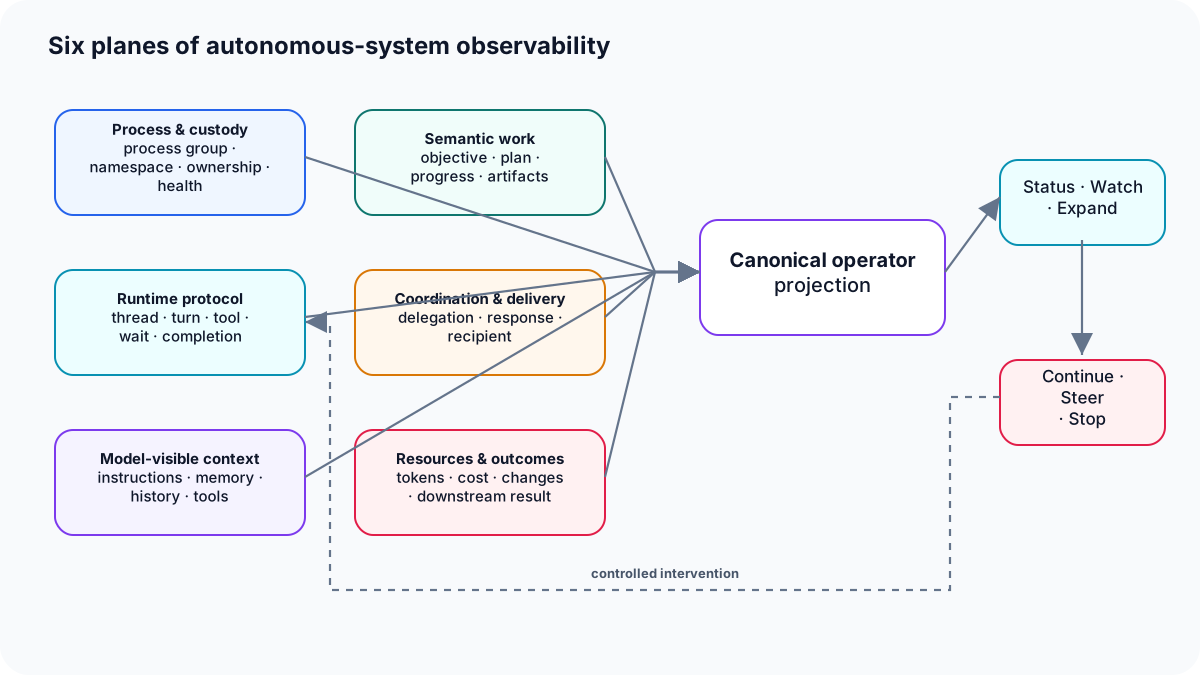
No single event store needs to own all six planes. In fact, it is often better when they retain specialized source formats. The important requirement is a stable identity model and a projection layer that can join them without inventing a second mutable version of the truth.
1. Process and Custody: What Is Actually Running?
A long-running autonomous worker should not be modeled as a synchronous function call with a generous timeout. It may continue after the launcher exits, spawn children, wait on remote systems, write artifacts over time, and require intervention hours later.
The first useful result of a launch is therefore not “task complete.” It is launch accepted.
A launch receipt can include:
- a stable run identity;
- the worker or role responsible for the run;
- the process and process-group identity;
- the runtime namespace or isolated workspace;
- the objective accepted by the runtime;
- the canonical command or view used to observe it.
We have used this pattern to launch detached work immediately, return custody confirmation to the caller, and let observation proceed independently through a durable status surface. The launcher does not have to hold open a terminal or parse a final block of stdout to know whether the runtime accepted the work.
Process custody adds information that a model span cannot provide:
- Is the operating-system process still present?
- Does it belong to this run or to another experiment?
- Which child processes belong to the same process group?
- Which runtime directory and namespace does the process own?
- Is the system authorized to terminate that process group?
- When was exit observed, even if no final application event arrived?
This is particularly important when several agent variants, background services, browser sessions, or evaluation runs coexist on one host.
A useful process ledger should be precise about its role. It is not necessarily the complete supervisor. It is the custody record that connects a semantic run identity to operating-system reality and to the authority required for controlled cleanup.
Why custody belongs in observability
Observation without custody is incomplete. A dashboard may show that a worker exists, but an operator still needs to know whether it is safe to stop, whether other work shares the same process tree, and which state should be retained afterward.
In practice, joining process identity with runtime identity gave us a clean operating pattern:
request accepted
→ detached process launched
→ process group registered
→ runtime events streamed
→ current state reduced
→ operator may continue, steer, or stop
→ terminal process state reconciled
This creates a durable lifecycle instead of a terminal-bound shell session.
2. Runtime Protocol: Replace Activity Noise With Semantic Progress
Agent runtimes can produce a vast quantity of activity:
- token deltas;
- reasoning deltas;
- partial messages;
- repeated heartbeats;
- tool-call fragments;
- network polling;
- child-worker status checks.
These records can be valuable for low-level diagnosis. They are not the best units for an operator trying to understand whether the work is moving.
We found greater operational value in a smaller set of semantic progress transitions:
- turn started;
- tool work began;
- tool work completed;
- waiting on an external dependency;
- delegation started;
- delegated result returned;
- turn completed;
- run reached a terminal state.
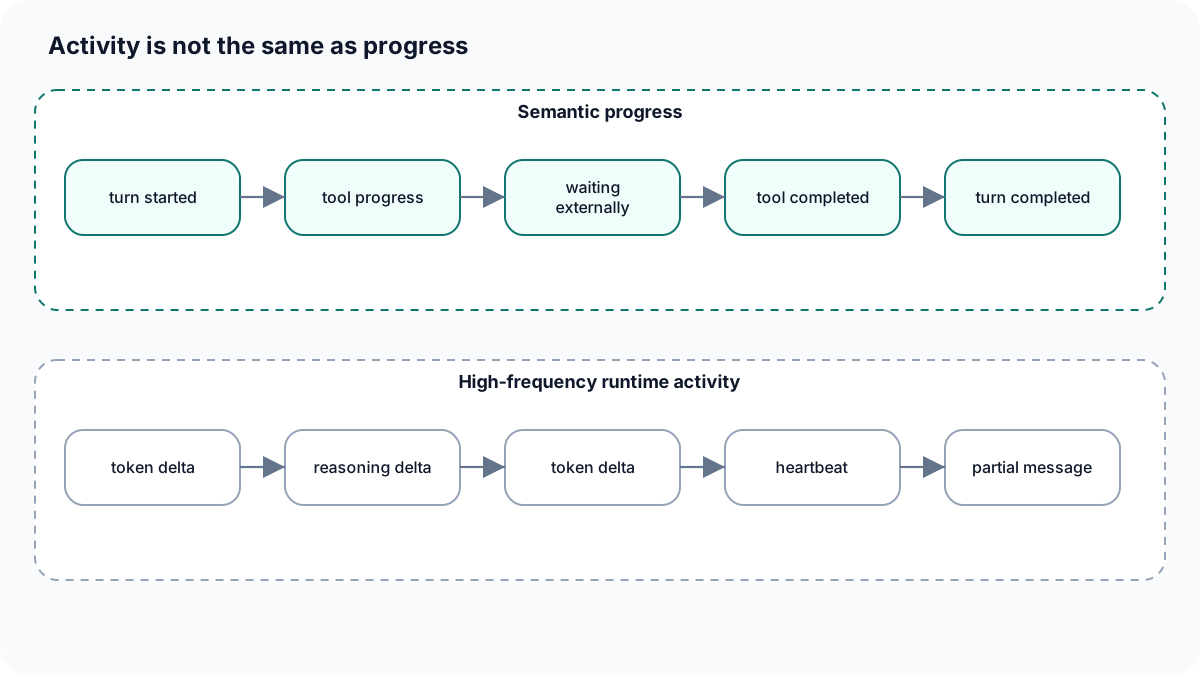
The difference becomes especially valuable with tool-using and multi-agent systems. A worker that is waiting for a browser session, a remote service, or a child result is in a meaningful state. “Waiting” is not absence of progress information; it is progress information.
Likewise, delegation should be observable as a lifecycle rather than as unrelated calls:
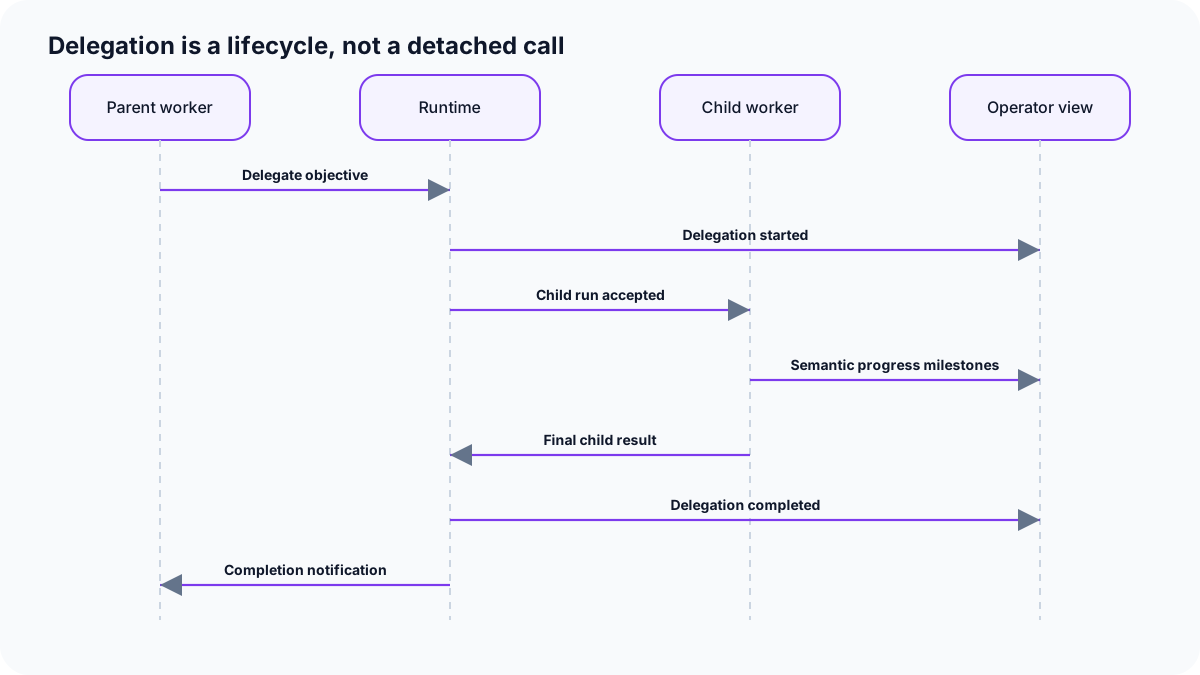
We used this structure to make spawned work visible without requiring constant parent polling. When the child completed, the parent received a structured completion notification and could continue with the result. That turns delegation into an observable operating primitive instead of a collection of loosely related model calls.
3. Model-Visible Context: What Did the Model Actually See?
Two runs can receive the same nominal user request and behave differently because the effective model request differed.
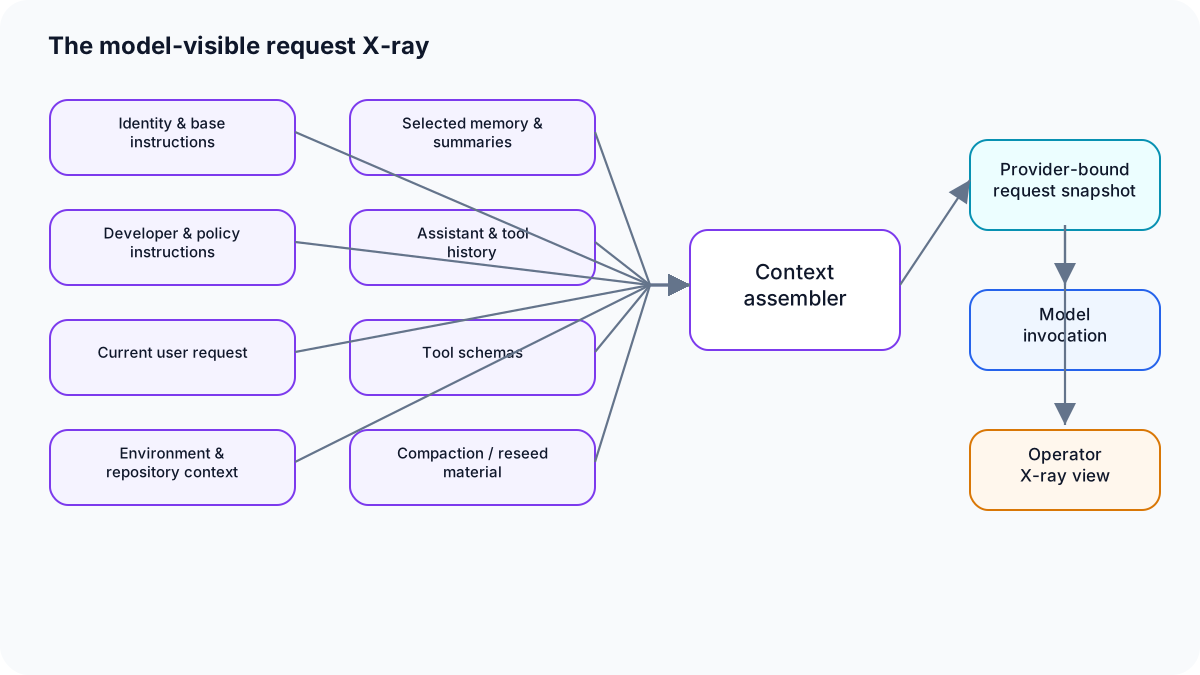
The runtime may have assembled:
- base instructions;
- developer or policy instructions;
- permissions and application instructions;
- the current user request;
- repository and environment context;
- selected long-term memory;
- recent conversation history;
- tool schemas;
- tool results;
- compacted or reseeded history;
- summaries generated during context maintenance.
A trace that records only the user prompt or an application-level request object cannot reconstruct this complete surface.
The model-visible request X-ray
We built request projections that classify provider-bound material along two axes:
- Endpoint role — the actual system, developer, user, assistant, or tool role transmitted to the model provider.
- Semantic surface — the purpose of the material inside the autonomous system: base identity, current task, environment context, memory, tool schema, compacted history, and so on.
This distinction is important. Environment context may travel through a user-role input item without being the user’s objective. A tool schema is model-visible despite not being an ordinary conversational message. Selected memory may be assembled into developer context while retaining its own source identity and freshness.
A model call needs a context receipt
The request snapshot becomes even more useful when joined with a context-selection receipt.
A context receipt can record:
- the active task and role;
- the query or retrieval objective;
- candidate-pool statistics;
- selectors and their weights;
- required or pinned material;
- summaries and synthetic context;
- final selected handles;
- dropped items;
- coverage relationships showing which summaries replaced which source units;
- estimated token occupancy;
- a durable handle to the complete rendered prompt when it is too large to store inline.
We used these receipts to inspect exactly which context was included, confirm that required material remained present, verify that summaries substituted for covered raw content, and connect context selection to later runtime and outcome records.
This creates a powerful debugging and evaluation question:
Did the model act this way because of its reasoning, or because the system assembled a different world around it?
Without a model-visible snapshot and selection receipt, that question is often impossible to answer precisely.
4. Semantic Work: What Changed Because the Agent Acted?
Runtime progress becomes more useful when it is joined to the state of the work itself.
For an autonomous coding system, relevant changes may include:
- files created or modified;
- patches or branches produced;
- tests or checks executed;
- generated artifacts;
- documentation updates;
- review comments or handoffs;
- results returned from delegated workers.
For a business automation system, relevant changes may include:
- a draft produced;
- a message classified;
- an internal task created;
- a customer reply delivered;
- an application submitted;
- a publishing workflow completed;
- a follow-up scheduled.
The operator view should not infer work progress solely from runtime motion. It should project the objective and the work-bearing artifacts alongside the runtime state.
A useful pattern is a runtime reducer that joins several authoritative sources:
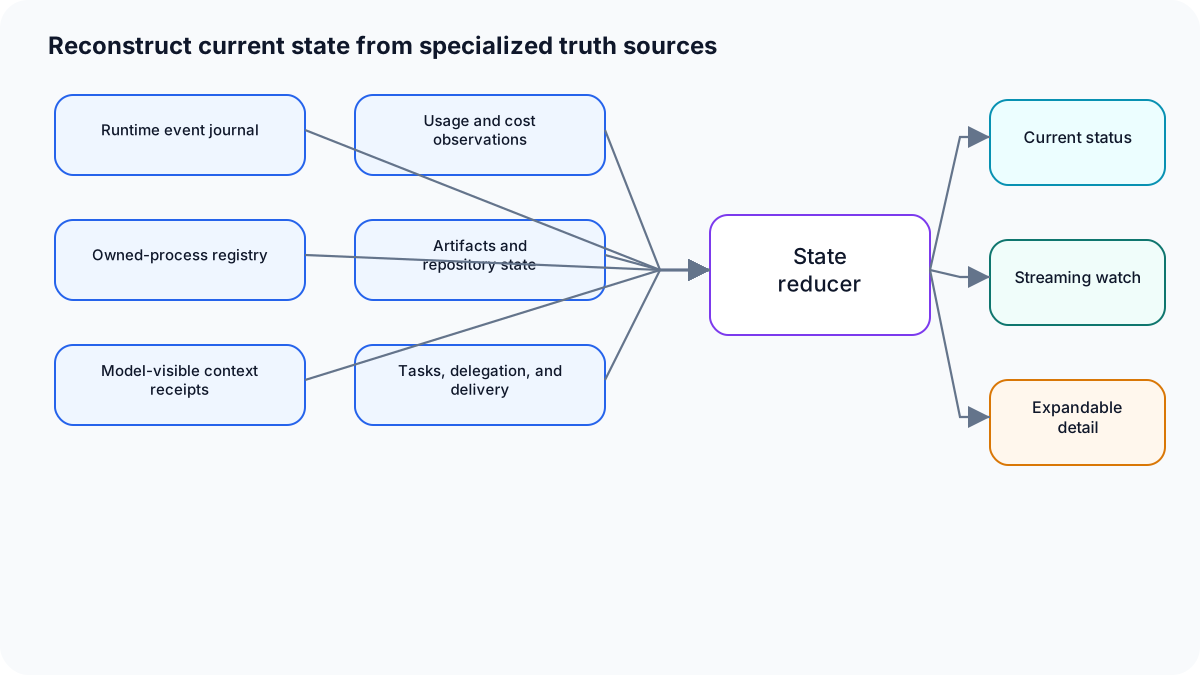
The reducer does not need to copy every source event into a universal event table. It can preserve specialized ledgers and compute an operator projection keyed by stable run, thread, turn, operation, and artifact identities.
This approach gave us concise live views while retaining deep expansion when an operator needed to inspect the full request, tool record, process tree, artifact, or cost lineage.
5. Coordination and Delivery: Did the Result Reach Its Destination?
Autonomous work often passes through several actors:
- a user or manager assigns an objective;
- a planner decomposes it;
- one or more workers execute portions;
- a reviewer or policy layer evaluates the result;
- another system publishes, merges, sends, or schedules the output;
- a recipient consumes it.
Observability should preserve that chain.
A child worker producing a result is meaningful. The parent receiving that result is another meaningful event. The parent incorporating it into the continuing plan is another. A backend task completing and a customer-facing result being delivered are similarly distinct stages.
This gives us a completion ladder:
request received
→ launch accepted
→ process started
→ runtime active
→ semantic progress observed
→ objective completed
→ result reviewed
→ result delivered
→ downstream effect observed
Each stage has its own proof source. The ladder allows a system to report the highest confirmed stage rather than compressing the entire lifecycle into one ambiguous success field.
We have used automatic parent notifications to return delegated results, durable communication records to preserve handoffs, and delivery-specific state to distinguish internal completion from external delivery. This makes autonomous workflows easier to operate because the location of the work remains visible even after it moves between workers and systems.
6. Resources and Outcomes: What Did the Work Consume and Produce?
Token totals alone are rarely enough for a long-running system.
Useful resource observation can distinguish:
- planning from implementation;
- parent work from delegated work;
- prompt input from generated output;
- cached input from newly processed input;
- current context occupancy from cumulative usage;
- a single turn from the full run;
- model usage from browser, compute, storage, or other resources;
- observed usage from attributed cost.
We have surfaced resource use alongside runtime state so operators could distinguish expensive progress from expensive activity. Context-window occupancy was especially useful: it revealed not only cumulative spend, but how close the active model-visible state was to a compaction or rotation boundary.
The strongest economic view connects usage to a stable operation identity:
resource observation
→ model / provider / tool
→ run / thread / turn / phase
→ objective or delegated work unit
→ produced artifact or delivered result
This does not require reducing every benefit to one number. It does make cost interpretable at the level where engineering decisions are made.
For example, an operator can compare:
- the planning cost of a run with its implementation cost;
- direct work with delegated work;
- context assembly cost with action cost;
- a compact context policy with a larger one;
- one runtime strategy with another under the same objective.
That turns observability into a foundation for system improvement rather than a passive archive.
The Closed Operator Loop
Observability creates value when it supports action.
A mature operator surface should provide three levels of interaction:
- Status — a bounded current-state projection.
- Watch — a streaming view that emits meaningful changes rather than repeating unchanged output.
- Expand — direct access to the underlying request, event, artifact, delegation, process, or cost record.
From that view, the operator or supervisory policy can issue structured interventions:
- continue with additional context;
- steer toward a revised objective or constraint;
- stop the owned process group;
- resume when an external dependency becomes available.
The intervention itself should be durable. A steer command should retain its target, reason, timestamp, and application result. A stop should connect the semantic run identity to the process group that was signaled. The resulting state transition should appear in the same operator projection.
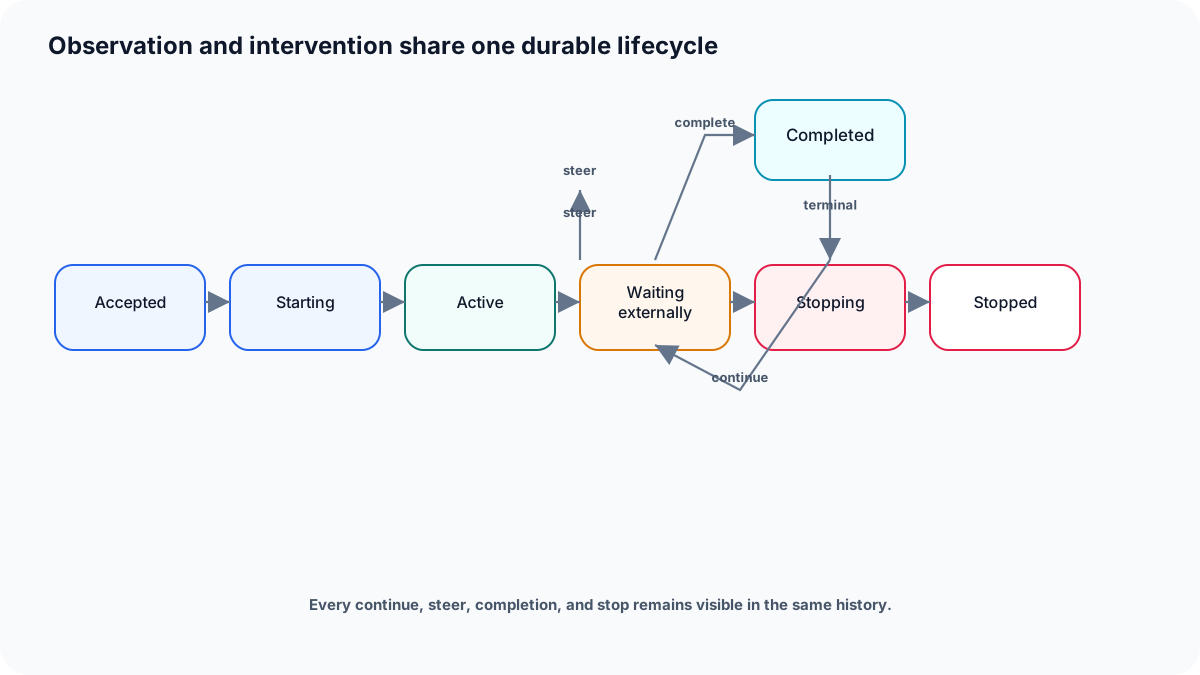
This closed loop supports both human supervision and automated policy. The same structured intervention can originate from an operator, a scheduler, a budget policy, a timeout policy, or a higher-level agent—while remaining visible in one history.
A Practical Example: Observing an Autonomous Engineering Run
Consider a long-running autonomous system asked to refactor a queue subsystem and update its tests and documentation.
A complete operating view might show:
At launch
- the objective was accepted;
- a detached process group was registered;
- the worker received a stable run identity;
- the operator received the canonical watch target.
At context assembly
- the model-visible request contained the current objective, repository instructions, selected design history, relevant source summaries, and the available tool schemas;
- the context receipt recorded which source units were included, which were represented by summaries, and the expected token occupancy.
During planning
- the run entered a planning phase;
- a child worker was delegated a focused investigation;
- the child’s semantic progress remained visible;
- its final result returned automatically to the parent.
During implementation
- tool milestones showed source inspection, file edits, and validation work;
- repository state exposed the files changed and artifacts produced;
- usage was attributed separately to planning, delegated investigation, and implementation.
At completion
- the runtime emitted a terminal work result;
- the process state reconciled with the terminal event;
- the changed files, checks, and report were available through expandable handles;
- the result moved into the next review or delivery stage.
The operator did not need to correlate terminal output, process listings, model-provider logs, child-worker transcripts, Git status, and cost reports manually. The system reduced them into one operational narrative while retaining direct access to each source.
That is the difference between collecting traces and operating autonomy.
Design Principles for Autonomous-System Observability
Stable identity across every plane
Runs, threads, turns, operations, delegations, artifacts, processes, and deliveries need stable identifiers. Identity is what allows specialized ledgers to join without becoming one monolithic database.
Append-only source events, derived current state
Runtime journals and intervention records should preserve history. Current status should be a reproducible projection, not another independently mutated truth store.
Semantic transitions over indiscriminate heartbeats
Keep raw events for diagnosis, but build operator views from meaningful milestones: started, tool progress, waiting, delegated, resumed, completed, delivered.
Receipts at lossy or mutating boundaries
Context selection, compaction, delegation, external action, publication, and intervention all transform or discard information. Record what entered the boundary, what came out, and why.
Freshness belongs in the projection
A current view should state when each source was last observed and whether important expected sources are absent. Freshness is part of operational meaning.
Model-visible state should be independently inspectable
The system should be able to reconstruct the provider-bound request without relying on the model to describe what it saw.
Bounded views over deep expandable history
Operators need concise status, not an unbounded event dump. The concise view should link to exact underlying records when deeper inspection is useful.
Runtime state, durable memory, and business state are different
A tool event may be operationally important without belonging in long-term memory. A completed backend task may still await customer delivery. Keeping these domains distinct produces clearer systems and clearer operator views.
The Observability Standard Autonomous Systems Need
As autonomous systems move from single-turn assistants to long-running workers, the observability problem changes.
The central question is no longer merely:
Did the model call succeed?
It becomes:
What world did the system see, what work did it attempt, how did that work progress, what did it change, what did it cost, where did the result go, and what can we do next?
Answering that question requires traces—but also process custody, model-visible request inspection, semantic progress, delegation lineage, artifact state, delivery state, cost attribution, and durable intervention.
The result is an operational model that supports confident autonomy:
- workers can run asynchronously;
- delegated work remains connected to its parent objective;
- operators can distinguish activity from meaningful progress;
- context assembly is inspectable;
- resource use is connected to actual work;
- produced artifacts and delivery stages remain visible;
- intervention is controlled and durable.
At Cognilode, we design the infrastructure around autonomous systems: the runtime protocols, context surfaces, memory layers, observation models, control planes, and evaluation loops that make sophisticated agentic behavior operable in real environments.
The goal is not another dashboard full of spans.
It is a system that can answer, at any moment:
What is this autonomous system doing, why is it doing it, what has changed, and what should happen next?
See what autonomous work meant, changed, cost, and delivered.
We connect traces with model-visible context, plans, delegation, runtime state, artifacts, cost, interventions, and delivery so operators can act on one coherent projection.
Related engineering notes

The Control Plane Outside the Agent
A practical architecture for operating autonomous AI systems with independent process custody, semantic health, runtime isolation, calibrated controls, and coherent rollback.
Read article →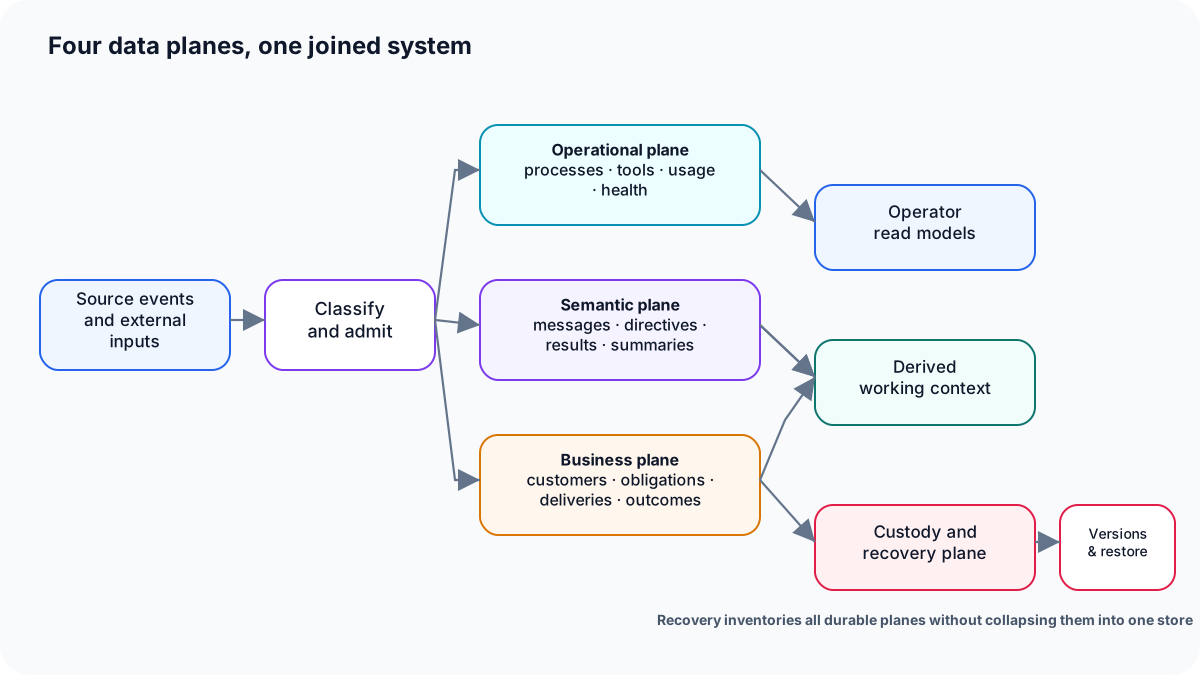
The Data Architecture of Long-Running AI Agents
A practical architecture for separating runtime events, durable memory, business state, derived context, and recoverable data in long-running autonomous systems.
Read article →