
The Architecture of Advanced Retrieval for Autonomous Systems
Beyond RAG: Building Adaptive Knowledge Systems for AI Agents
This research informs the hands-on architecture and implementation work Cognilode delivers for engineering teams.
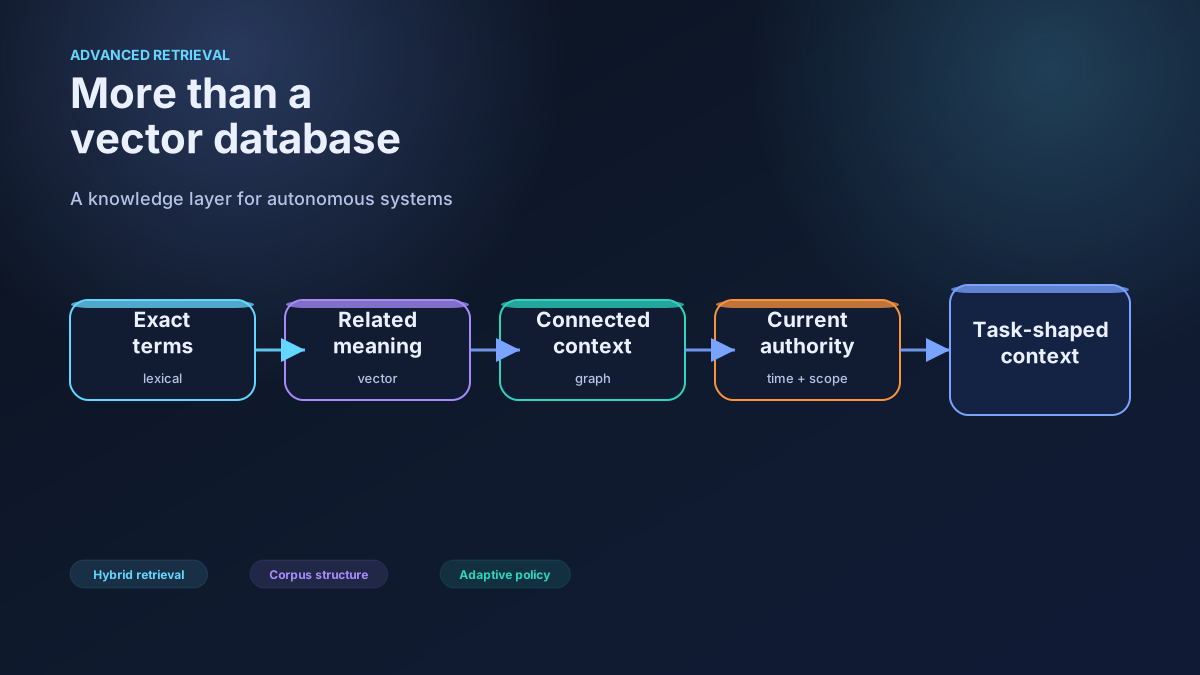
Most retrieval-augmented generation diagrams end at the same place: split documents into chunks, create embeddings, run a nearest-neighbor query, and place the top results into a model’s context window.
That pattern is useful. It is also only the beginning.
A long-running autonomous system works across changing source code, documentation, conversations, operational records, prior decisions, and the results of earlier work. It must distinguish an exact identifier from a related concept, a current implementation from an obsolete one, a direct dependency from a coincidental similarity, and a useful summary from the source material that summary compresses. It must retrieve enough context to act well without flooding the model with redundant or weakly related material.
That requires more than a vector database. It requires a knowledge architecture: a coordinated system for transforming information, exposing several complementary retrieval views, organizing large corpora, maintaining continuity as knowledge changes, and learning from how retrieved context is actually used.
At Cognilode, we have built and iterated on this class of infrastructure across code repositories, documentation collections, conversation histories, runtime traces, and multi-agent workflows. The implementations changed over time, but a durable set of principles emerged.
The central lesson is simple:
Advanced retrieval is not a search feature attached to an AI system. It is the knowledge layer through which the system perceives its world.
Why AI Agents Need More Than a Vector Database
Vector search answers one important question: Which items occupy nearby regions in a learned feature space?
Autonomous systems routinely need several other questions answered at the same time:
| Retrieval signal | Question it answers | Typical use |
|---|---|---|
| Lexical search | Where do these exact names or phrases appear? | Symbols, configuration keys, error strings, product terminology |
| Vector search | What expresses a similar meaning with different words? | Concept discovery, paraphrases, related designs |
| Graph retrieval | What is structurally or historically connected? | Imports, callers, containment, renames, cluster membership |
| Temporal scoring | What is recent enough to matter now? | Current operating state, fresh decisions, recent failures or fixes |
| Namespace and scope | Which corpus or authority should count most? | Code versus docs, current stock versus archive, team-specific knowledge |
| Hierarchical retrieval | What broader subject contains this detail? | Topic navigation, summaries, progressive context expansion |
These signals are not interchangeable. An exact function name should usually be treated differently from a conceptual question. A file that imports the changed module may be more operationally relevant than a semantically similar file in an unrelated subsystem. A recent decision may deserve more weight than an older discussion, while a foundational specification may remain important regardless of age.
A mature retrieval system therefore behaves less like a single database query and more like a query planner. It decides which retrieval channels to activate, how deeply to search, how to combine the results, when to rerank them, and how much context to deliver.
That is the point where retrieval becomes architecture.
A Retrieval Stack, Not a Retrieval Trick
The most useful mental model is a braided pipeline. Several retrieval channels inspect the same query from different angles, then converge into one ranked and explainable result stream.
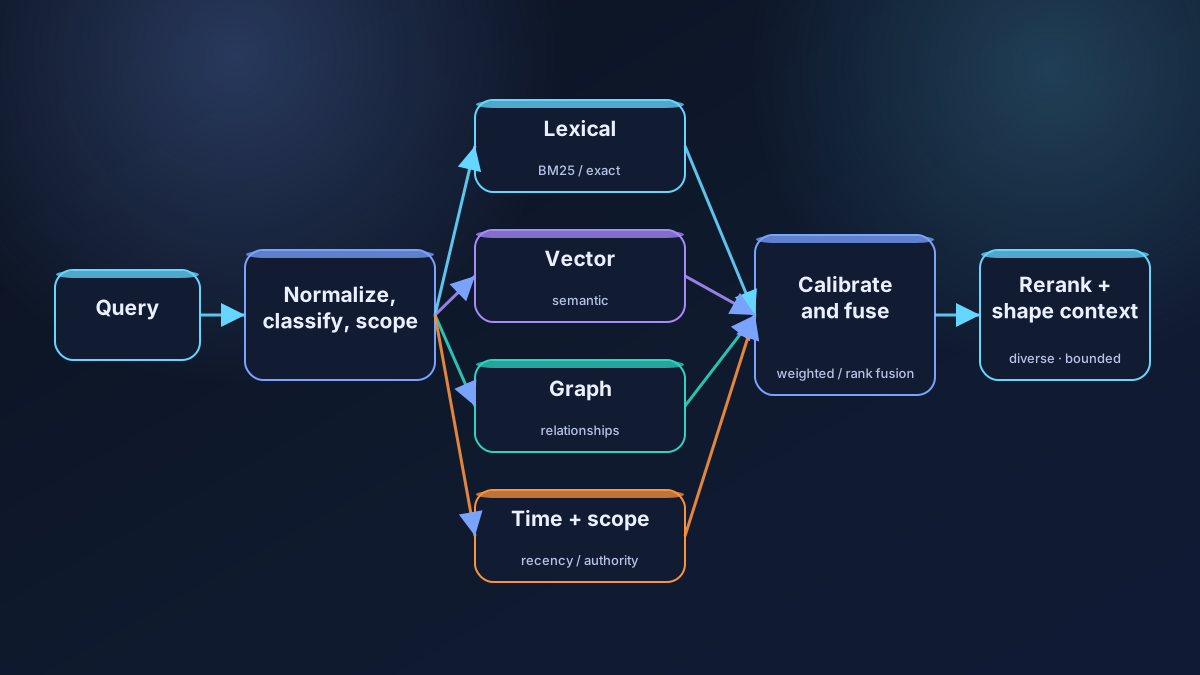
The pipeline has five distinct responsibilities.
First, normalize and classify the query. Is it an exact identifier, a conceptual request, an impact-analysis question, a request for recent operational context, or some combination? Query shape should influence retrieval policy.
Second, execute several retrieval channels. A lexical index may search exact terms. A vector index may search semantic representations. A graph layer may expand from strong seeds into imports, callers, renames, related topics, or parent-child relationships. Time and namespace policies may restrict or reweight candidates.
Third, calibrate and fuse the candidates. Raw BM25 values, cosine similarities, graph weights, and recency scores do not naturally share one scale. They must be normalized or combined through rank-based methods.
Fourth, rerank selectively. Expensive rerankers are most useful after high-recall retrieval has created a manageable candidate set. They should not be treated as mandatory for every query.
Finally, shape the result for the task. The best output is often not a flat top-k list. An autonomous coding task may need the implementation, its callers, the relevant tests, the latest design note, and one concise historical summary. A research task may need broader topic coverage and more diversity. Retrieval should produce a context packet, not merely a scoreboard.
Build Stable Knowledge Before Ranking It
Retrieval quality is constrained by the quality of the units being retrieved.
A source tree is not naturally a knowledge base. Neither is a directory of Markdown files, a collection of chat logs, or an append-only stream of runtime events. Before ranking begins, the system needs a dependable way to turn those sources into addressable units.
In our implementations, the ingestion layer produced several useful granularities:
- file-level units for broad ownership and path retrieval;
- chunk-level units for local semantic and lexical search;
- symbol-level units for functions, classes, and other code structures;
- conversation-event units for user, assistant, tool, and system events;
- relationship records for containment, imports, calls, and other structure.
The key is not merely chunking. It is preserving identity and lineage.
A chunk should retain its source file, span, language, normalization mode, and ordering. A symbol should retain its file and location. A normalized conversation event should retain its session and turn position. When a file is renamed, the knowledge layer should be able to follow that lineage rather than treating the new path as an unrelated object.
For append-only logs, incremental cursors matter. A practical ingester should remember byte offsets, process only complete records, tolerate a partially written final line, detect file replacement, and preserve corruption as inspectable data rather than silently discarding the entire stream.
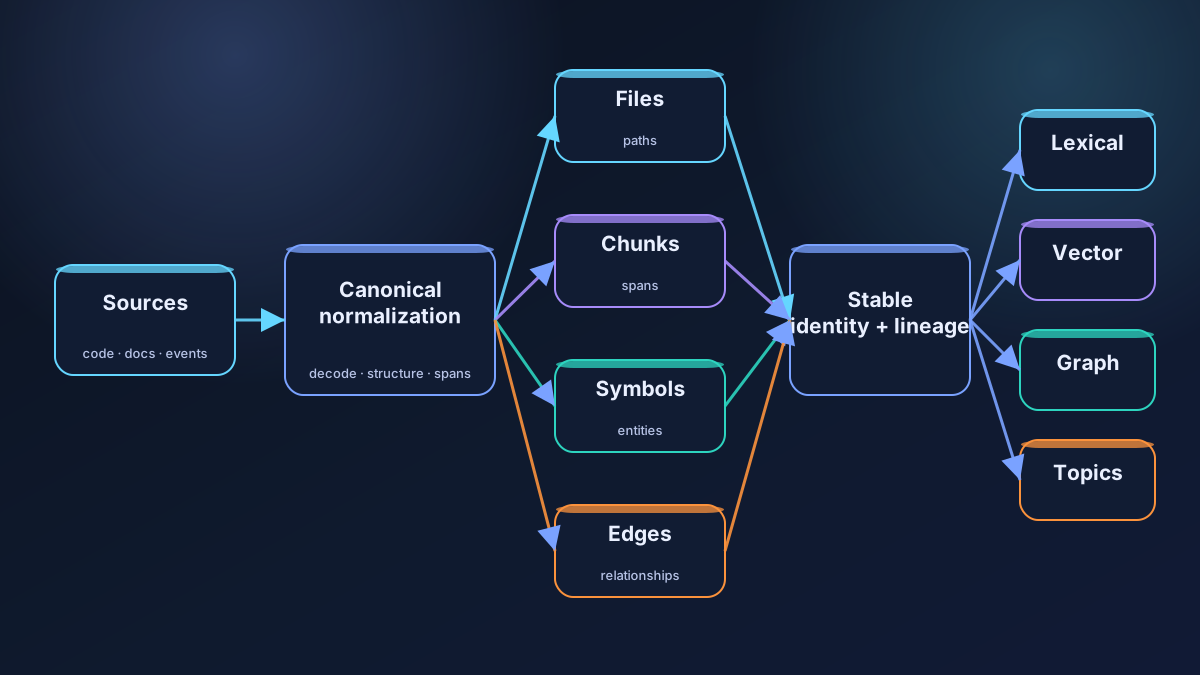
This structure pays off repeatedly. Exact lookup becomes reliable. Graph edges can point to durable entities. Clusters can be compared across runs. Summaries can expand back to their children. Retrieval logs can identify which precise units were selected and used.
The engineering principle is:
Do not ask a ranking algorithm to compensate for an unstable corpus model.
Fuse Signals Without Erasing Their Meaning
The simplest hybrid retrieval formula is a weighted sum:
S(d) = \alpha L(d) + \beta V(d) + \gamma G(d) + \delta T(d)where lexical, vector, graph, and temporal scores have first been calibrated into comparable ranges.
This can work well when score distributions are stable and understood. But different providers often produce values with very different shapes. BM25 may be unbounded and query-dependent. Cosine similarity may cluster tightly. Graph weights may reflect path depth, relationship type, and time decay. One provider may return twenty candidates while another returns hundreds.
Rank-based fusion is often more robust. A weighted reciprocal-rank formulation looks like this:
R(d) = \sum_i \frac{w_i}{k_0 + \operatorname{rank}_i(d)}Each retrieval channel contributes according to where the item ranked, with a channel-specific weight. This preserves the value of strong agreement across channels without pretending that the raw scores were identical measurements.
The weights should not be universally fixed.
A short query that resembles an identifier may place more weight on lexical precision. A broad conceptual query may favor semantic retrieval. An impact-analysis query may activate graph expansion after finding strong lexical or vector seeds. A request for current operating state may apply stronger recency and namespace policies.
The result object should preserve those contributions. Instead of returning only 0.83, it can expose a compact explanation:
Result: retry_policy.py
Fused rank: 1

Exact-term signal     █████████░ 0.91
Semantic signal       ███████░░░ 0.72
Relationship signal   ████████░░ 0.84
Freshness signal      ██████░░░░ 0.63

Why it ranked:
- contains the exact configuration key
- imported by the active queue worker
- referenced by a recent implementation note
This is useful for operators, but it is also useful for the autonomous system itself. The system can distinguish a direct match from an inferred association and can decide whether to expand, verify, or seek another source.
Selective reranking and diversity
Reranking is valuable when a high-recall first stage has collected plausible candidates. A cross-encoder or model-based reranker can evaluate query-document pairs with more nuance than an approximate nearest-neighbor index.
But reranking everything is wasteful, and reranking every query can reduce precision for exact lookups. A mature router can choose among several behaviors:
- preserve lexical-first order for identifier-like queries;
- rerank a semantic shortlist for ambiguous conceptual queries;
- apply graph-aware boosts for impact analysis;
- use maximum marginal relevance to reduce redundant chunks;
- cap repeated results from the same file, topic, or namespace.
The objective is not simply to maximize similarity. It is to maximize the usefulness of the complete context set.
Relationships Are a Retrieval Primitive
A vector index can tell us that two passages are semantically close. It cannot, by itself, tell us that one file imports another, that one function calls another, that a document was renamed, that a chunk belongs to a particular summary, or that two items were placed in the same cluster during a prior analysis.
That is the role of a knowledge graph.
For retrieval, the graph should be bounded and purpose-specific. Starting from strong lexical or vector hits, the system may expand one or two hops over selected relationship types:
CONTAINSIMPORTSCALLSRENAMED_TOSIMILAR_TOMEMBER_OF_TOPICSUMMARIZED_BY
The graph should not indiscriminately flood the candidate pool. Degree caps prevent hubs from dominating. Hop limits bound cost. Relationship-specific weights distinguish direct dependencies from looser associations. Time decay can reduce the influence of stale operational relationships while leaving durable structural facts intact.
This combination is particularly useful in software work. Suppose an autonomous system is asked to change retry behavior in an ingestion service. Lexical retrieval finds the configuration key. Vector retrieval finds design notes about backoff semantics. Graph expansion finds the active worker that imports the configuration, the tests that call the worker, and the renamed predecessor of the current module. The final context packet is far stronger than any one channel could produce.
Graph retrieval is therefore not a replacement for semantic search. It is the mechanism that turns good search seeds into operationally meaningful neighborhoods.
From Vector Search to Living Knowledge Systems
A knowledge system becomes “living” when it can reorganize a changing corpus without forcing every user or agent to rediscover its structure from scratch.
Large corpora contain repetition, near-duplicates, superseded explanations, broad themes, narrow subtopics, and families of documents that differ only in details. Retrieving every item independently wastes context and makes rankings noisy.
We addressed this through a corpus-compression pipeline with several stages.
Deduplicate with multiple levels of confidence
Near-duplicate discovery benefits from a cascade rather than one universal threshold.
Exact hashes catch identical content cheaply. MinHash or locality-sensitive techniques find high-overlap candidates. Fuzzy string comparison captures edited variants. Vector similarity catches semantic restatements. Structural signals can add a small bounded bonus when two code units share meaningful shape or relationships.
The important design choice is to keep the signals separate long enough to explain why a pair was accepted. A high-overlap text pair is different from two conceptually similar documents, and both are different from two files connected by a shared code structure.
Represent clusters with medoids and exemplars
Once related items form a cluster, the retrieval layer does not always need to index and return every member equally.
A medoid is an actual member that best represents the center of the cluster. It can serve as the first retrieval target. A small exemplar set preserves important variation around that center. The system can expand the cluster only when the task needs more detail.
This produces two benefits: the initial result set becomes less repetitive, and the context budget can be spent on broader coverage.
Build bounded topic hierarchies
Flat clustering is useful, but many corpora naturally contain topics and subtopics. We implemented bounded hierarchical clustering that produced a tree with configurable maximum depth, minimum leaf size, maximum leaf size, and target leaf count.
Each leaf topic could carry:
- a human-readable label;
- a short summary;
- a medoid or exemplar set;
- recent members;
- a path through the broader topic hierarchy.
The hierarchy was deliberately bounded. An unconstrained tree is difficult to navigate, expensive to summarize, and prone to creating tiny topics with little practical value.
Preserve topic identity as the corpus changes
Rebuilding a topic tree creates a subtle problem: cluster labels and local numeric IDs can change even when the underlying subject is mostly the same.
A living knowledge system should preserve continuity.
We used overlap-based projection to map newly discovered leaf clusters onto stable topic identities from the previous build. When a topic remained substantially the same, it retained its identity. When one topic split into two, the system recorded that lineage. When two topics merged, the relationship was preserved instead of silently replacing history.
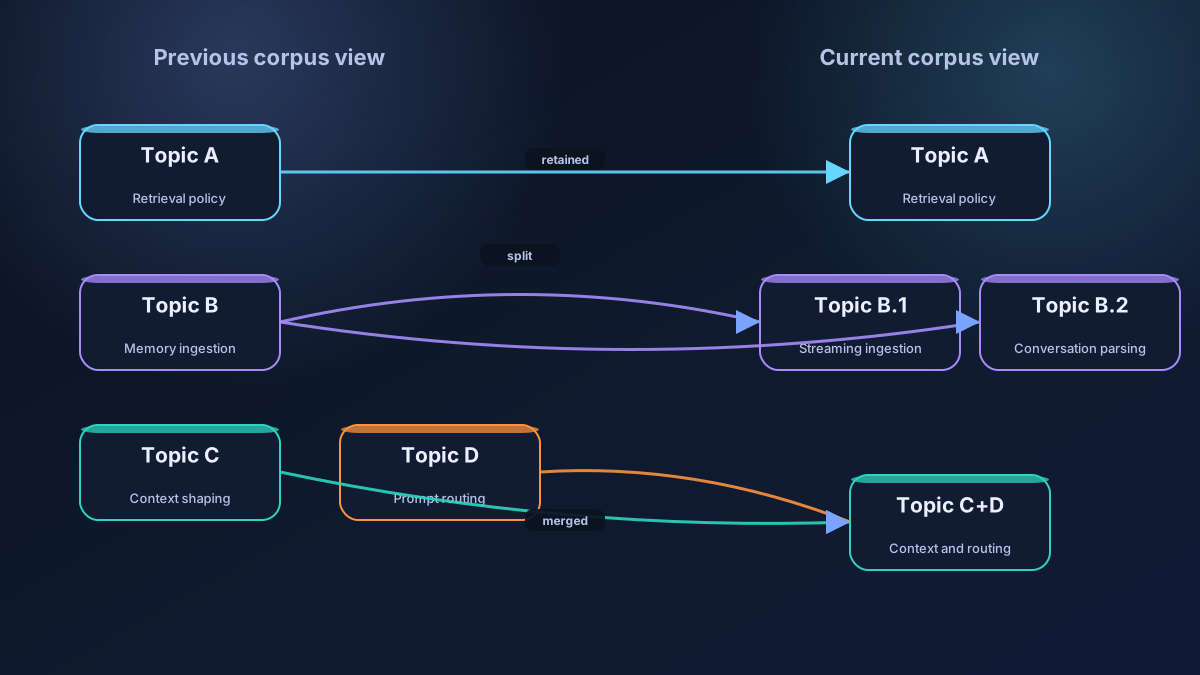
This matters for autonomous systems because a stable topic identity becomes a durable handle. Retrieval policies, summaries, operator links, and prior outcomes can remain attached to the topic even as its membership evolves.
Compression Without Amnesia
Summaries are useful only when they do not become dead ends.
A common memory design stores a generated summary and discards or obscures the precise material it summarizes. That saves tokens, but it weakens later verification and makes correction difficult.
A stronger design treats each summary as an expandable handle:
Long-range summary
    ↓ exact child links
Medium-range summaries
    ↓ exact child links
Short summaries
    ↓ exact child links
Source chunks or message blocks
The expansion path should follow stored child relationships, not launch a new similarity search and hope to rediscover the right material. This makes compression reversible and allows an autonomous system to progressively reveal detail only when needed.
The same principle applies to topic cards. A topic card can begin with a label, a compact description, several exemplars, and recent members. If the task requires more detail, the system can expand into the leaf documents, then into exact source spans.
This creates an efficient context strategy:
- Start with high-level topic and summary handles.
- Expand only the branches relevant to the current task.
- Preserve exact links to source material throughout.
- Avoid loading every underlying document into the model at once.
This is how a large knowledge base becomes navigable within a finite context window.
Shared Memory for Multiple Autonomous Workers
Once several autonomous workers operate over the same environment, local memory files are not enough. Each worker may produce conversations, tool traces, decisions, intermediate artifacts, and completed work. Without a shared layer, useful knowledge remains stranded on the node that created it.
We developed a network-local memory pattern with three responsibilities:
Local capture. Each worker writes append-only logs and artifacts close to the process that produced them.
Incremental synchronization. File watchers and periodic pollers process only new complete records, maintain cursors, and publish normalized units into a shared namespace.
Central serving. One service owns persistent state and exposes search, expansion, and queue operations to the worker network.
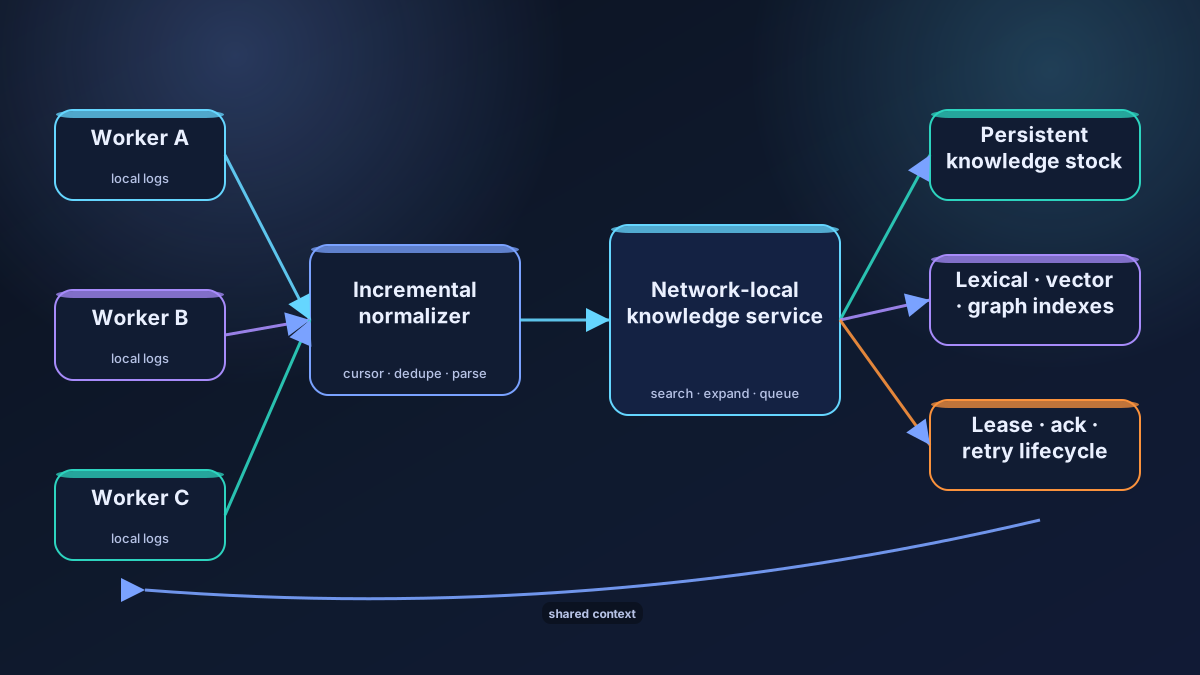
The queue operations are not incidental. A shared knowledge service often becomes the natural place to coordinate work items associated with that knowledge. Lease, renew, acknowledge, reject, sweep, and in-flight inspection operations prevent several workers from treating the same item as unowned or simultaneously executable.
For public-facing architectures, the broader lesson is that retrieval, memory, and coordination increasingly converge. Once knowledge is shared across agents, lifecycle semantics become part of the knowledge system.
Make Retrieval Improve With Use
An advanced retrieval system should not assume that its first policy is permanently correct.
Every lookup creates useful learning data. A query produces candidates. Each candidate has ranks and scores from several channels. Some items are selected, expanded, or ignored. The autonomous system then performs work, and that work has an outcome: completion, rework, cost, latency, user approval, or later correction.
Those events can form a retrieval-learning loop.
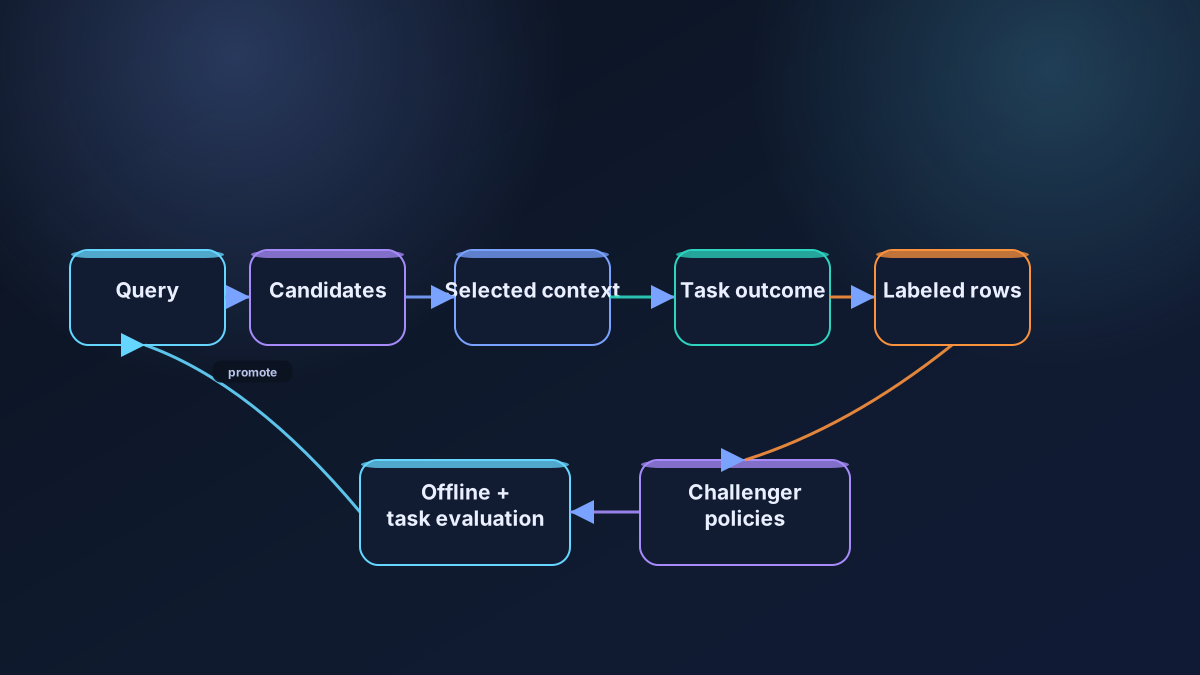
A labeled lookup row can retain the query, candidate, rank, fused score, lexical contribution, vector contribution, graph contribution, namespace, policy weights, and relevance label. This supports conventional retrieval evaluation such as recall, mean reciprocal rank, and normalized discounted cumulative gain.
But offline relevance is not the whole objective. For autonomous systems, the better questions are operational:
- Did the selected context reduce unnecessary exploration?
- Did the system edit the correct component?
- Did it locate an existing implementation instead of recreating it?
- Did the task complete with less rework?
- Was the context compact enough to preserve reasoning capacity?
- Did the retrieval policy stay within latency and compute budgets?
This leads naturally to champion-and-challenger policies. A stable production policy serves current work. Challenger policies are replayed against labeled datasets and selected task traces. A challenger is promoted only when it improves the agreed combination of retrieval quality, task success, latency, and cost.
Adaptation should be controlled, not mysterious. The purpose is not to let every query mutate the system. The purpose is to turn real use into structured feedback for deliberate policy improvement.
What Advanced Retrieval Looks Like in Practice
Consider an autonomous engineering system asked to change retry behavior in a distributed ingestion pipeline without breaking queue semantics.
A basic vector search may return several documents discussing retries. An advanced retrieval architecture can assemble a much stronger context packet:
- Lexical retrieval finds the exact retry configuration key, queue status names, and relevant command-line flags.
- Vector retrieval finds design notes that describe backoff and lease-renewal behavior using different terminology.
- Graph expansion finds the worker that imports the policy, the queue operations it invokes, the tests that exercise renewal and rejection, and the renamed predecessor of the current module.
- Topic retrieval finds the stable topic covering queue lifecycle and the most representative prior implementation notes.
- Temporal and namespace policy favors current source and current operational documentation over archived experiments.
- Diversity control prevents six nearly identical chunks from the same file from consuming the context window.
- Context shaping returns the implementation, affected callers, tests, one concise design summary, and expandable links to deeper history.
The autonomous system begins with a coherent model of the work rather than a bag of semantically similar text.
That difference is the practical value of knowledge architecture.
Design Principles for Advanced Retrieval
The implementations described above suggest several durable engineering principles.
1. Build stable units before sophisticated ranking
Identity, source spans, and relationships make every later retrieval and compression operation more reliable. Poor corpus structure cannot be rescued indefinitely by a stronger embedding model.
2. Treat retrieval channels as complementary sensors
Exact terms, semantic similarity, graph relationships, time, and namespace answer different questions. Preserve their distinctions through the fusion process.
3. Use graphs for bounded expansion, not uncontrolled traversal
Strong lexical and vector hits make good graph seeds. Hop limits, degree caps, relationship filters, and time-aware weights keep expansion useful and predictable.
4. Compress the corpus without losing the path back
Clusters, medoids, exemplars, topic cards, and summaries should reduce context cost while retaining exact expansion routes to source material.
5. Stabilize concepts across rebuilds
Topic continuity matters. Preserve identities when subjects remain substantially the same, and record split-and-merge lineage when the structure changes.
6. Rerank selectively and optimize the context set
The goal is not the highest individual similarity score. The goal is a compact, diverse, task-complete context packet.
7. Learn from downstream use
Retrieval traces become much more valuable when connected to selection, expansion, task completion, cost, and rework. Evaluate policies on the work they enable.
8. Design shared memory as a service with lifecycle semantics
Multiple autonomous workers need authoritative ingestion, idempotence, persistent indexes, and queue ownership—not merely access to the same directory.
The Knowledge Layer Is Part of the Agent
The industry often treats retrieval as an accessory: a database call made before the “real” intelligence begins.
For autonomous systems, that separation is misleading.
The system’s behavior depends on what it can find, what it considers related, what it treats as current, how it compresses prior experience, and which parts of a large corpus it places into working context. Retrieval policy directly shapes planning, editing, verification, and learning.
The most capable systems will therefore move beyond a single embedding index toward adaptive knowledge layers that:
- transform heterogeneous sources into durable units;
- combine lexical, semantic, structural, temporal, and hierarchical retrieval;
- organize corpora through deduplication, exemplars, summaries, and evolving topics;
- share memory across autonomous workers;
- and improve ranking policy from real usage and outcomes.
That is the architecture of advanced retrieval.
It is also one of the most consequential engineering surfaces in any serious autonomous system.
Make your agent’s knowledge layer adaptive, inspectable, and production-ready.
Cognilode can audit corpus structure, retrieval signals, ranking quality, and feedback loops—then implement the highest-leverage fixes in your stack.
Related engineering notes

The Control Plane Outside the Agent
A practical architecture for operating autonomous AI systems with independent process custody, semantic health, runtime isolation, calibrated controls, and coherent rollback.
Read article →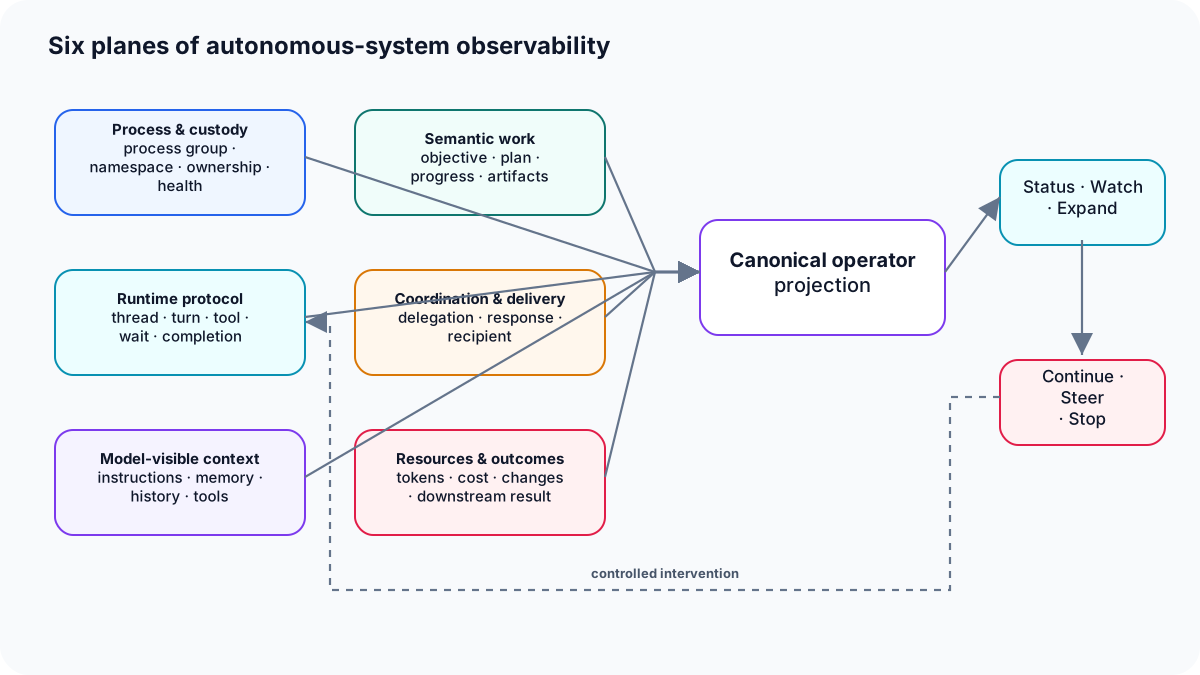
Why Agent Traces Are Not Enough
A practical architecture for observing what autonomous systems saw, decided, delegated, spent, changed, and delivered—not merely which API calls completed.
Read article →