
Evaluating Autonomous Systems Beyond Task Completion
Decision-to-outcome graphs, real-task trials, delayed metrics, and the learning loop behind production-grade agents
This research informs the hands-on architecture and implementation work Cognilode delivers for engineering teams.

A model call ends. A workflow reaches its final node. A patch appears. A status field changes to completed.
That is where conventional evaluation often stops—and where meaningful evaluation of autonomous systems should begin.
The most important question is not whether an agent produced activity. It is whether the activity became useful: whether a proposed change could be incorporated, whether a decision improved the system after enough time had passed, whether a customer received the right result, whether the outcome justified the cost, and whether the organization learned something that should alter future behavior.
This becomes increasingly important as autonomous systems move beyond short, isolated prompts. A long-running agent may make dozens of decisions, call several tools, delegate work, create intermediate artifacts, operate across changing state, and produce consequences that unfold over hours or days. The first visible result may be only one step in a longer causal chain.
At Cognilode, we have built evaluation infrastructure around that reality: versioned decision-to-outcome graphs, multi-horizon measurement, real-task comparative trials, isolated runtime environments, semantic review of work products, downstream delivery checks, cost and risk dimensions, and datasets that connect agent decisions with later consequences.
The result is a different view of evaluation:
An autonomous system should be evaluated as a participant in a changing environment—not as a function that returned a value.

Evaluation Begins Where the Run Ends
A green run can tell us that software executed. It cannot, by itself, tell us that the work mattered.
Consider an autonomous coding system. It may produce a syntactically valid patch and pass a focused test. The richer evaluation asks:
- Does the change address the actual system objective?
- Is the design direction appropriate for the surrounding architecture?
- Can an engineer review and integrate the useful portion without excessive reconstruction?
- Does the behavior remain valuable when exercised in the real runtime?
- Did the work reduce future effort or merely move complexity elsewhere?
Now consider an autonomous business workflow. A backend task may be marked complete, but the real outcome may depend on whether the artifact is good enough to deliver, whether the correct person receives it, whether the external message accurately describes the result, and whether the delivery occurs exactly once.
Or consider an autonomous content system. A title rotation, upload-route decision, or configuration change cannot be judged fully at the moment it executes. The environment needs time to respond. The meaningful signal may arrive an hour later, a day later, or after several subsequent jobs.
These cases share a common structure:
objective
→ agent decisions and actions
→ work product
→ integration or delivery
→ immediate consequences
→ delayed consequences
→ future policy change
Each arrow represents an evaluation boundary. Collapsing the entire chain into one boolean loses the information needed to understand what the system actually accomplished.
The solution is not to create a giant universal rubric for every run. The solution is to preserve the distinctions that matter, then choose the relevant dimensions for the workflow being evaluated.
Decisions, Outcomes, Feedback, and Time
The fundamental evaluation object is not the completed run. It is the relationship between a decision and the outcomes that followed.
A production-oriented evaluation system can represent three basic event types:
- Decision events — selections, plans, tool calls, configuration changes, routing choices, generated actions, or delegated work
- Outcome events — observable changes in the system or environment after a decision
- Feedback events — human responses or review judgments that apply to one or more decisions
These events form a graph rather than a one-to-one table.
One decision may produce several outcomes. Several decisions may contribute to one outcome. Human feedback may refer to an entire sequence rather than a single action. A later event may change how an earlier decision should be interpreted.
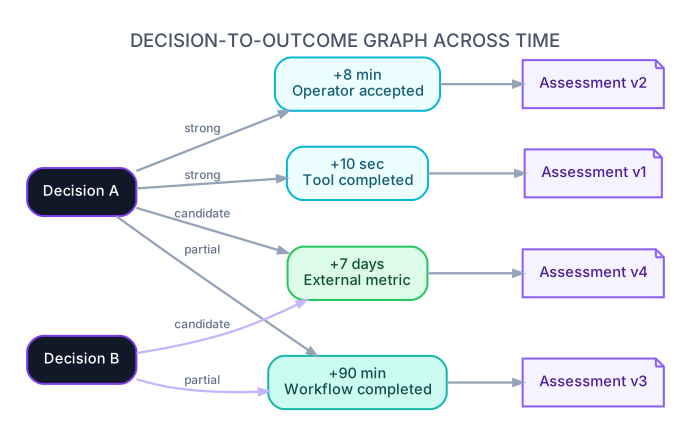
Multiple horizons, not one verdict
We implemented outcome collection across explicit time windows. A generic pattern might include:
- Immediate: seconds after the action
- Short: several minutes
- Medium: hours
- Long: a day or more
- Extended: later refreshes when the workflow produces slower external signals
The exact windows depend on the application. The important design choice is that the system does not assume the first observable result is the final verdict.
For example:
Decision at t0
   ├── +10 seconds: tool action completed
   ├── +8 minutes: operator accepted the result
   ├── +90 minutes: downstream workflow completed
   ├── +24 hours: change remained in active use
   └── +7 days: external metric reflected the decision
This allows evaluation to follow the natural rhythm of the system. A browser action may have a meaningful immediate state change. A software change may need integration and later operational use. A content decision may need several metric windows. A customer-delivery workflow may need an external response or downstream business event.
Versioned judgments
When later evidence arrives, the evaluator should not overwrite history. It should append a better-informed assessment with a new evidence cutoff.
Assessment v1 — immediate execution result
Assessment v2 — operator used or integrated the result
Assessment v3 — downstream workflow outcome
Assessment v4 — retention, revision, or external effect
This preserves two kinds of truth at once:
- what was knowable at the time; and
- what became clear later.
That distinction is useful for debugging, learning, and policy design. It also prevents hindsight from making every early decision look more obvious than it really was.
Contribution links with confidence
A robust outcome graph should retain several candidate contribution links when causality is uncertain. Each link can carry:
- the source decision and destination outcome;
- a relationship type;
- a weight;
- confidence;
- the reason the relationship was proposed;
- the records that support it.
Explicit identifiers are the strongest linkage. Shared task, artifact, conversation, pull request, content, or run identifiers also help. Time proximity is useful but should remain a candidate signal rather than an automatic claim of causality.
The result is an evaluation system that can say:
“This outcome is strongly linked to Decision A, partially linked to Decision B, and may also reflect an external factor.”
That is more honest and more useful than forcing one action to receive all the credit.
A Multidimensional Outcome Profile
A single score is convenient for ranking. It is often too lossy for understanding.
We used multidimensional outcome profiles to keep separate signals visible. A practical profile may include:
- Objective completion — did the system accomplish the assigned goal?
- Semantic usefulness — is the result actually valuable in context?
- Human acceptance — did the relevant reviewer or user approve the result?
- Immediate operational effect — what changed right away?
- Long-horizon contribution — did the work remain useful or enable later success?
- Integration effort — how much expert work was required to make the result real?
- Resource cost — what models, compute, tools, and time were consumed?
- Risk and reversibility — what was the blast radius, and how easy was recovery?
- Delivery quality — did the result reach the correct destination in an appropriate form?
- Attribution confidence — how certain is the connection between action and outcome?
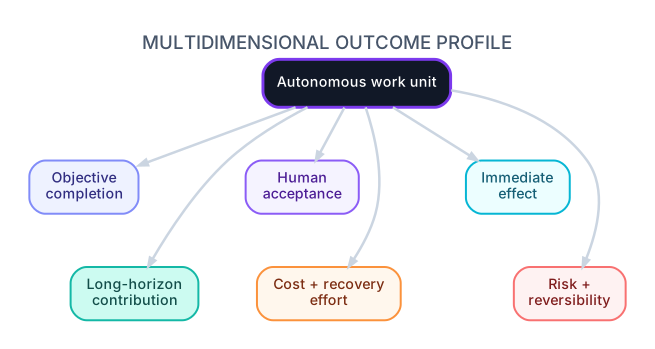
The profile is not a demand that every run generate ten numbers. It is a vocabulary for selecting the right evaluation dimensions.
A code-generation trial may emphasize semantic usefulness, integration effort, runtime behavior, and cost. A customer-delivery workflow may emphasize artifact quality, delivery accuracy, safety, and exactly-once behavior. A content operation may emphasize delayed metrics, resource use, and retention of the change.
A scalar may still be derived for optimization or routing. The crucial point is that the scalar should remain a projection of richer data—not the only durable record of the outcome.
This also creates a natural evaluation ladder:
cheap deterministic linkage
→ learned evaluator for common patterns
→ stronger semantic evaluator for uncertain cases
→ expert review for high-impact decisions
The system spends interpretation effort where ambiguity and impact justify it.
Real-Task Trials and Net Useful Value
Micro-benchmarks are valuable for isolating capabilities. They are less effective at measuring whether an autonomous system can perform useful medium-horizon work inside a real codebase or business process.
Real tasks expose qualities that short benchmarks often miss:
- continuity across several steps;
- use of repository- or organization-specific context;
- scope control;
- architectural judgment;
- recovery from intermediate uncertainty;
- integration quality;
- ability to produce something another person or system can use.
Equivalent realities, not merely identical prompts
A fair comparison requires more than giving two systems the same sentence.
The evaluated variants may depend on:
- code and repository state;
- durable databases and memory;
- model and runtime identity;
- current working context;
- permissions and credentials;
- network posture;
- available tools;
- time and resource budgets.
When those conditions matter, the evaluation environment should bind them explicitly.
We developed bounded alternate-reality trials that could separate:
- repository snapshots;
- durable semantic data;
- temporary runtime identity;
- owned processes;
- model and reasoning configuration;
- external-action authority;
- resource observations;
- produced artifacts;
- cleanup or rollback operations.
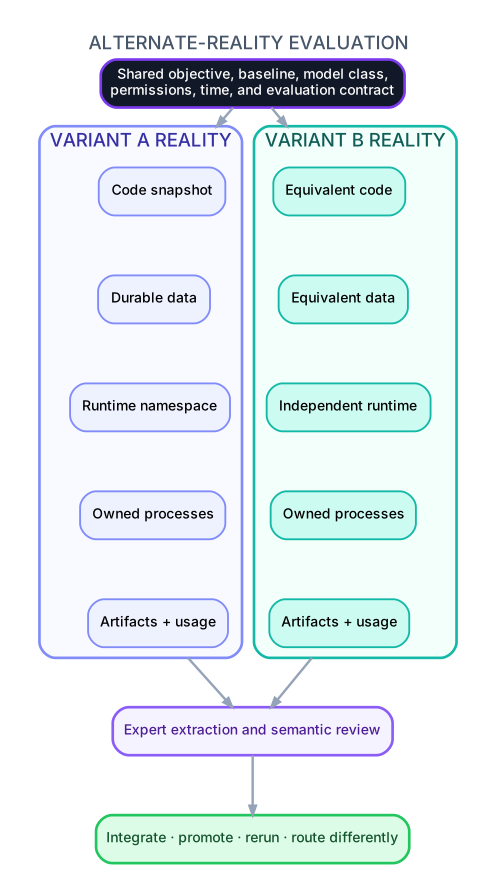
This distinction is especially important for memory-augmented or long-running systems. A repository copy alone may not reproduce the system’s actual operating reality. Durable context, runtime homes, message history, sockets, profiles, or local databases may materially influence behavior.
Evaluation by extractable value
The most useful scoring principle we found was simple:
The value of a candidate is the useful work that can be reviewed, adapted, and made real—not the quantity of output it produced.
This leads to a conceptual model:
net useful value
  = integrated usefulness
  − expert recovery effort
  − resource cost
  − introduced risk
The terms do not need to share one perfect numerical unit. The decomposition is valuable because it prevents technical neatness from dominating semantic judgment.
A candidate may contain an excellent architectural idea with a small localized defect that is inexpensive to repair. Another may be polished but misaligned with the real objective. Real-task evaluation should distinguish those cases.
A concrete observed result
In one controlled coding-agent comparison, a candidate produced a process-local reentrancy safeguard for a managed runtime. The evaluator reviewed the candidate, refined the scope of the guard, and integrated the useful behavior into the operating codebase.
The incorporated safeguard:
- prevented nested execution of the same managed role in the same repository;
- released active state reliably after exceptions;
- preserved independent execution across separate repository roots.
The evaluation result was not the candidate patch or a nominal winner label. It was the runtime improvement that became real.
That is the practical purpose of agent trials: not to manufacture a leaderboard, but to discover which designs, behaviors, and implementation fragments deserve to enter the production system.
Evaluation Through Delivery
For business automation, internal completion is only one stage of the outcome.
A system may correctly classify an inbound request, create a work item, assign an autonomous worker, produce an artifact, and mark the work complete. The customer still has not received value until the result is reviewed, packaged appropriately, and delivered through the correct channel.
We evaluated complete delivery loops using real workflow projections and realistic scenarios. The evaluation packet could include:
- the inbound message and conversation identity;
- task and work-item records;
- assigned owner;
- completion notes;
- artifact or result references;
- outbound draft or sent communication;
- external-action receipt;
- event timeline.
The reviewer then judged whether the result should be delivered, revised, escalated, or intentionally withheld.
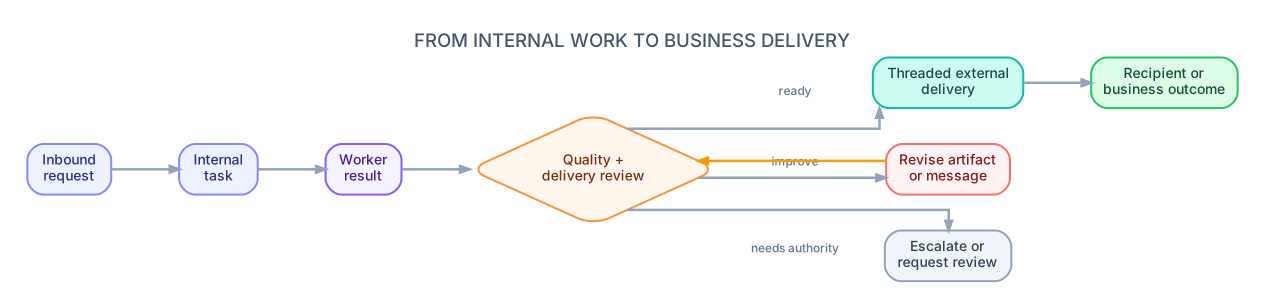
This architecture allowed us to evaluate subtle but important cases:
- a client defect report leading to a concrete repair and a safe delivery message;
- a business-looking vendor pitch correctly remaining outside the delivery workflow;
- a credential request receiving a narrow secure-access response rather than an unsafe action;
- backend work being converted into a polished customer-facing delivery by the correct point of contact;
- a large project being represented honestly as partial progress rather than premature completion;
- duplicate inbound messages producing one delivery path;
- an automated notice producing internal work without an unnecessary external response.
The broader lesson is that delivery semantics belong inside the evaluation architecture.
A pull request URL is not automatically a deliverable. A generated report is not automatically ready to send. A completed work item is not automatically customer value. The final outcome depends on the quality of the artifact, the accuracy of the message, the recipient, the timing, and the external effect.
This is where evaluation becomes inseparable from product design. The system must record enough business context to answer whether the work was useful in the form the recipient actually needed.
Delayed Outcomes in Autonomous Content Operations
Many operational decisions reveal their value only after the environment has had time to respond.
In an autonomous content pipeline, we assigned durable identities to high-leverage decisions such as:
- planning content jobs;
- rotating titles or thumbnails;
- modifying control configuration;
- selecting an upload route;
- requeueing or reclaiming work.
Relevant decisions were scheduled for later observations at multiple horizons—for example, one hour, six hours, 24 hours, and seven days.
A resumable background process:
- read the pending outcome ledger;
- identified due checkpoints;
- collected the relevant metrics;
- attached the new outcome to the original decision;
- marked the checkpoint complete idempotently.
This created a real asynchronous evaluation loop:
operational decision
→ durable identity
→ scheduled observation windows
→ idempotent metric collection
→ versioned outcome assessment
→ future policy learning
The same design generalizes to many enterprise systems:
- sales follow-up choices measured through later replies and conversions;
- infrastructure changes measured through later reliability windows;
- support responses measured through reopen and escalation behavior;
- routing decisions measured through task completion, latency, and rework;
- recommendations measured through later acceptance or continued use.
The key is to design the outcome clock around the workflow rather than around the model request.
Cost and Risk Belong Inside the Evaluation—But Do Not Define It
A production agent can be useful and expensive. It can be low-cost and unhelpful. It can produce a strong result while using a route that creates unnecessary operational exposure.
That is why cost and risk should remain explicit dimensions.
A useful accounting layer can attach resource observations to stable operations across asynchronous processes and subprocesses. It can distinguish:
- observed resource use;
- priced resource use;
- use attributed to a particular task, turn, worker, or artifact;
- benefit that has actually been accepted or observed.
These are different facts.
Knowing exactly what an autonomous system cost is necessary for operating it responsibly. It does not, on its own, tell us whether the work was worth doing.
The same is true of risk. A risk score should not erase the context of the action. Evaluation should record blast radius, reversibility, external authority, and mitigation alongside usefulness and cost.
This supports better routing decisions. A high-impact, difficult-to-reverse action may justify stronger evaluation and human review. A local, reversible transformation may be promoted more quickly after repeated successful outcomes.
From Evaluation to Learning
Evaluation becomes strategically valuable when it changes what the system does next.
Versioned outcome data can support:
- choosing between model or runtime variants;
- promoting a challenger policy;
- deciding whether to integrate a candidate change;
- routing similar future work differently;
- selecting when stronger review is needed;
- training a reranker, critic, or decision model;
- identifying high-cost paths that produce little durable value;
- expanding the responsibilities of a proven autonomous worker.
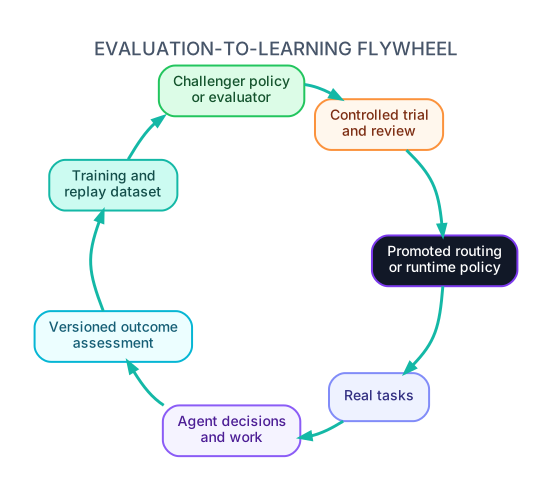
A practical learning pipeline can join each decision with:
- the context visible at decision time;
- the selected action or tool call;
- immediate and delayed outcomes;
- human feedback;
- cost and risk observations;
- confidence and evaluation method;
- later revisions.
These rows can then train or evaluate a challenger. High-confidence common patterns may be handled by a lower-cost learned evaluator. Uncertain or novel cases can be escalated to a stronger semantic evaluator or expert reviewer.
The promotion process should remain controlled:
real tasks
→ versioned outcome labels
→ training or replay dataset
→ challenger evaluator or policy
→ isolated comparison
→ promotion decision
→ future real tasks
This closes the loop between operations and learning without allowing every noisy signal to mutate the production policy automatically.
A Practical Architecture for Autonomous-System Evaluation
The historical implementations can be synthesized into six phases.
1. Define the evaluation contract
Before the run, record the real objective, starting state, expected work product, relevant time horizon, comparison conditions, cost and risk budget, and the evidence needed for later judgment.
2. Capture three planes of activity
Execution plane: decisions, messages, delegations, tools, model identity, process state, and intermediate artifacts.
Work-product plane: code, documents, communications, repository changes, test results, and operator attempts to use the output.
Outcome plane: human feedback, immediate system effects, delayed workflow events, business delivery, later retention or revision, cost, and risk.
3. Construct candidate contribution links
Use explicit IDs first, then shared task or artifact identifiers, time windows, feedback position, and bounded semantic adjudication. Preserve several candidates and confounds when the relationship is uncertain.
4. Produce a multidimensional assessment
Choose the dimensions relevant to the workflow. Keep the full profile inspectable even when a scalar is derived for ranking.
5. Append later assessments
New evidence should create a later version rather than rewrite the earlier judgment.
6. Make the evaluation operational
Use the result to integrate, deliver, rerun, escalate, promote, route, retrain, or decline broader authority.
This architecture makes evaluation part of the system rather than an after-the-fact report.
The Real Goal: Useful Autonomy That Improves
The purpose of evaluation is not to build a larger leaderboard.
It is to make autonomous work legible enough that an organization can decide:
- what to trust;
- what to integrate;
- what to deliver;
- what to promote;
- what to review more carefully;
- what to learn from.
The most capable autonomous systems will not be judged only by whether they can finish tasks. They will be judged by whether they can create durable value across time, operate within economic and risk constraints, deliver outcomes to real users, and improve their future decisions from the consequences of their past ones.
That requires an evaluation layer designed with the runtime and the business workflow—not added later as a dashboard.
At Cognilode, we design and implement these layers for teams moving from agent demonstrations to dependable autonomous operations: real-task trials, outcome attribution, long-horizon evaluation, cost and risk accounting, delivery verification, and learning loops that connect agent behavior to what happened next.
Because the most important question is rarely “Did the agent finish?”
It is:
“What became better because the agent acted—and what should the system do differently next time?”
About Cognilode
Cognilode helps teams design and implement advanced infrastructure for autonomous and agentic systems. Our work spans retrieval, long-running memory, runtime supervision, governed experimentation, outcome evaluation, cost attribution, computer-use systems, multi-agent coordination, and production integration.
Build an evaluation loop that improves autonomous work in production.
We design real-task trials, decision-to-outcome lineage, delivery checks, delayed metrics, and reusable evidence so agent improvements are grounded in business outcomes.
Related engineering notes

The Control Plane Outside the Agent
A practical architecture for operating autonomous AI systems with independent process custody, semantic health, runtime isolation, calibrated controls, and coherent rollback.
Read article →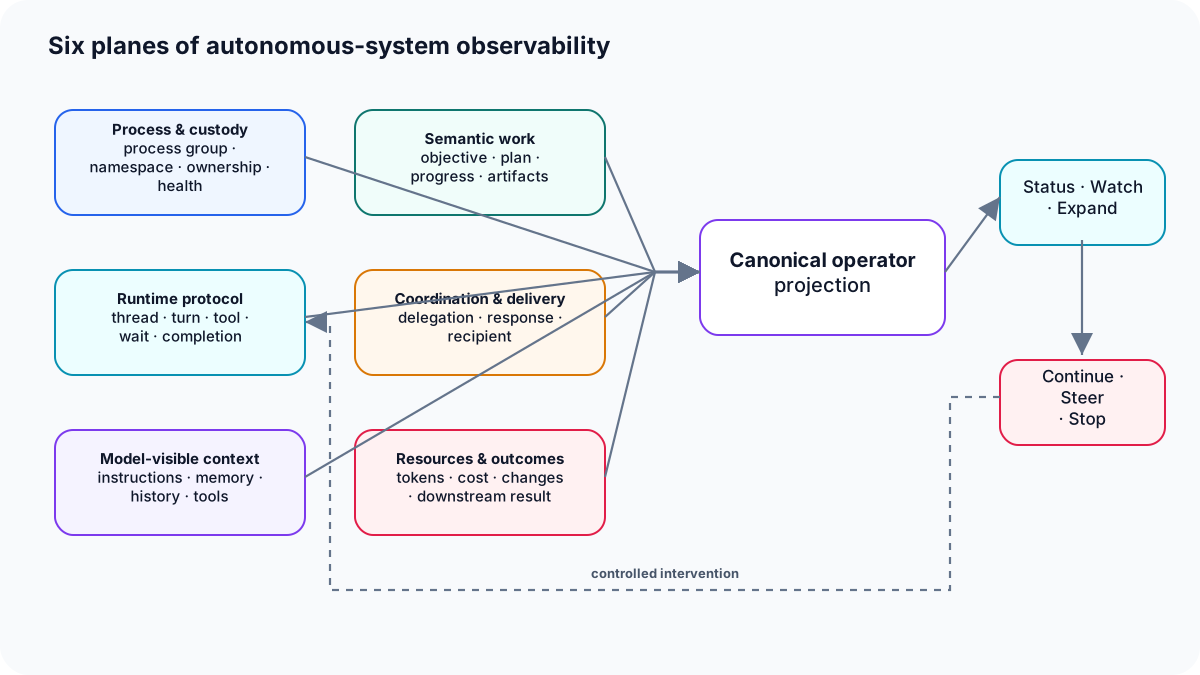
Why Agent Traces Are Not Enough
A practical architecture for observing what autonomous systems saw, decided, delegated, spent, changed, and delivered—not merely which API calls completed.
Read article →