
Parallel Realities: The Architecture of Governed Experimentation for Autonomous Systems
Beyond Agent Benchmarks: Testing Real Work in Controlled Environments
This research informs the hands-on architecture and implementation work Cognilode delivers for engineering teams.
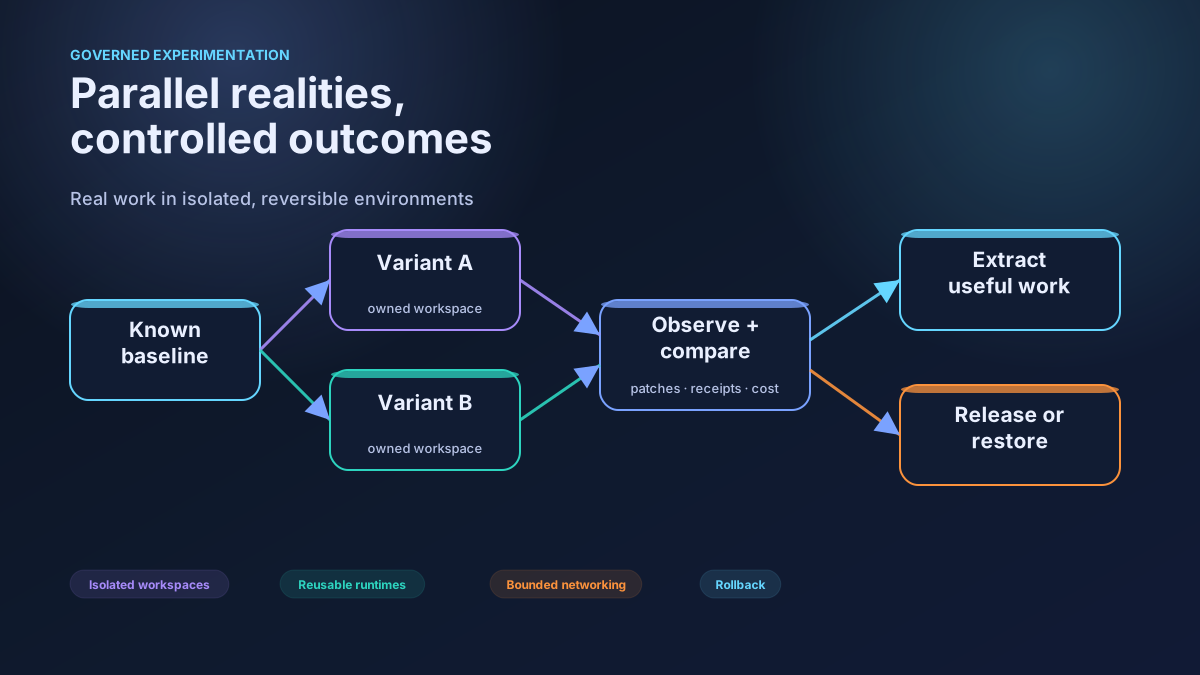
Most evaluations of AI agents compare outputs.
One model produces a plan. Another produces a patch. A benchmark scores the answers, and the higher number wins.
That is useful when the system under evaluation only generates text. It is insufficient when the system can change a repository, launch a process, update a database, consume a shared quota, modify a browser profile, communicate with another service, or leave behind state that affects the next run.
For an autonomous system, the experimental unit is not merely a response. It is a temporary reality.
That reality has a source state, a workspace, dependencies, processes, network access, credentials, cost, durable data, external-action authority, produced artifacts, and a way to end. Comparing two autonomous systems therefore requires more than sending them the same prompt. It requires creating comparable worlds in which they can perform real work without silently contaminating one another or the production environment.
At Cognilode, we have built and iterated on infrastructure for this class of experiment: parallel repository workspaces, dependency-fingerprinted runtimes, scoped processes and namespaces, bounded network access, external-action ownership, quota observations, patch extraction, deterministic cleanup, snapshots, and composed rollback.
The central lesson is:
A trustworthy agent trial is a transaction over mutable reality: create an owned environment, run one or more variants under comparable conditions, preserve what each changed, evaluate usefulness separately from process success, and either extract the valuable work or release and restore every resource the trial owned.
Why Prompt-Level A/B Tests Are Not Enough
A conventional model evaluation assumes that the input is fixed, the output is self-contained, and the environment is not materially changed by inference.
Autonomous systems violate all three assumptions.
An engineering agent may inspect thousands of files, install a dependency, create a branch, launch a test server, modify generated assets, or update a local index. An operations agent may read credentials, call external APIs, schedule follow-up work, or alter a browser session. A long-running worker may write memory, spawn child processes, accumulate cost, and leave a queue item in an in-flight state.
The result cannot be evaluated from the final answer alone.
| Evaluation question | Output-only benchmark | Governed real-work trial |
|---|---|---|
| What state did the system begin from? | Usually implicit | Fixed baseline with a durable identity |
| What did it change? | Final text or patch only | Files, processes, data, network actions, and artifacts |
| Were variants comparable? | Same prompt, sometimes same model | Same baseline, runtime class, model settings, limits, and task |
| Did one run contaminate another? | Rarely considered | Separate mutable workspaces and runtime ownership |
| What did the run cost? | Often one aggregate number | Per-variant tokens, time, infrastructure, retries, and repair |
| Can useful work be retained safely? | Copy the answer | Extract a patch or artifact into a trusted apply path |
| Can everything else be released? | Not applicable | Deterministic cleanup and, where necessary, rollback |
The deeper problem is that autonomous evaluation mixes two very different questions:
- Did the machinery run?
- Did the run produce something worth keeping?
A process can exit successfully while producing a poor design. A test suite can pass while the change solves the wrong problem. A run can fail late after producing a highly valuable partial implementation. A variant can create an excellent artifact while consuming too much time or requiring too much repair to be economical.
A governed trial preserves enough of the world to answer those questions separately.
The Trial as an Owned Alternate Reality
A useful trial begins by turning one task into several controlled worlds.
Each world receives the same intended baseline and an explicit set of parity conditions: model, reasoning configuration, time allowance, token allowance, dependency shape, and task definition. Each variant then receives its own mutable workspace, runtime, process identity, output directory, and accounting boundary.
Only the resources inside that envelope belong to the trial. That ownership rule is what makes reliable cleanup possible later.
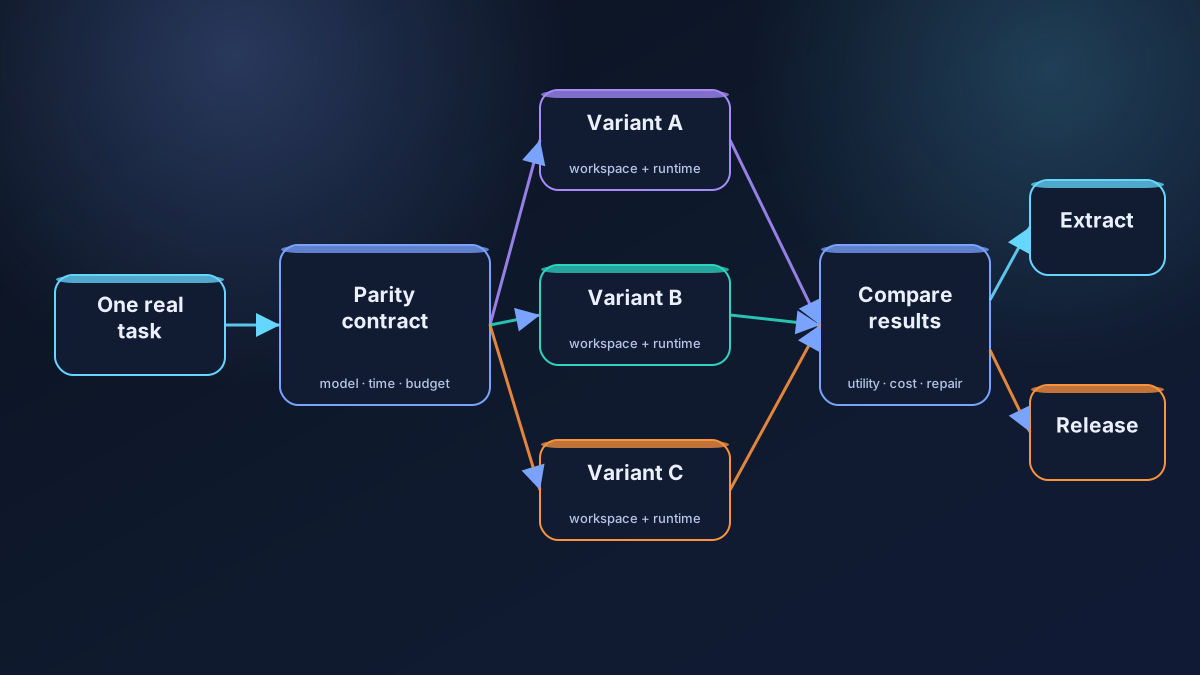
The design is deliberately broader than a container. A container may be one implementation tool, but the actual contract is semantic:
- Which files can this variant mutate?
- Which processes belong to it?
- Which runtime and dependency state does it use?
- Which durable data can it read or write?
- Which network destinations are available?
- Can it perform a real-world action?
- How is its cost measured?
- Which snapshot or data version could restore the prior state?
- What must be cleaned when the trial ends?
Different experiments need different answers. The architecture should make those choices explicit rather than assuming one universal sandbox profile.
The Trial Resource Envelope
The cleanest way to reason about a trial is as an owned resource envelope.
The task is at the center. Around it sit increasingly consequential layers of mutable reality.
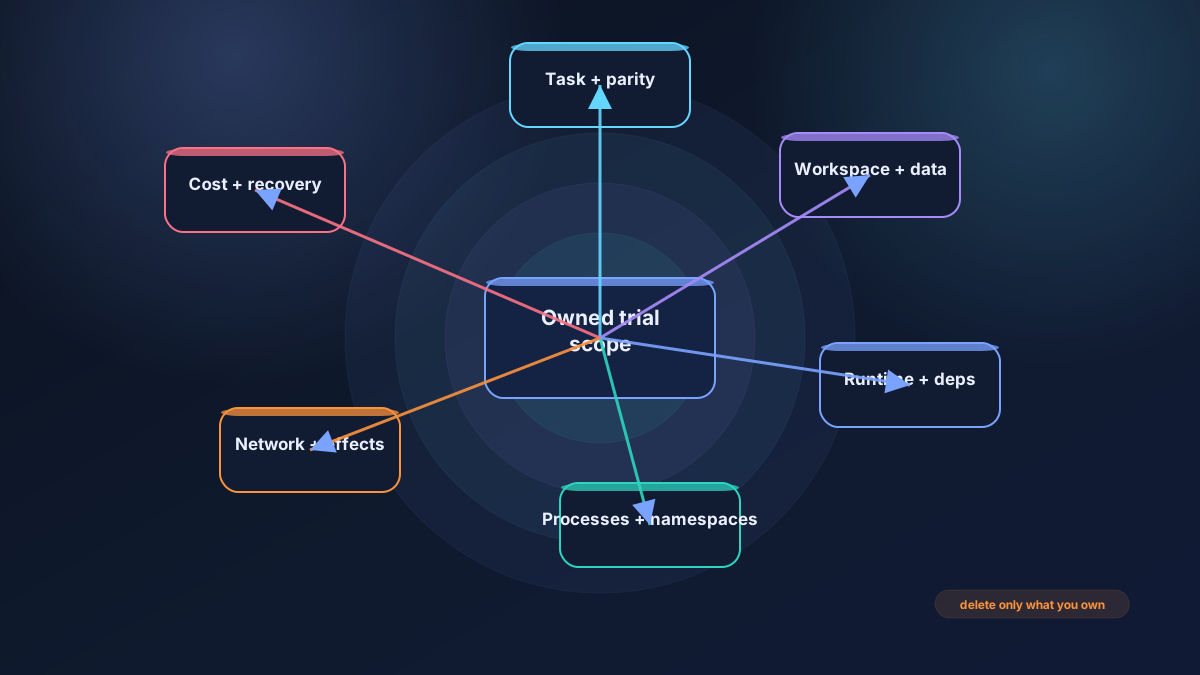
The envelope provides a practical invariant:
If the trial cannot prove that it owns a resource, it should not delete, stop, release, or restore that resource during cleanup.
This matters most when experiments run on development machines or shared infrastructure. Broad cleanup scripts are dangerous because they infer ownership from names, ports, or filesystem location. An explicit scope can instead record process identifiers, namespace identifiers, runtime roots, action capabilities, and snapshot references at creation time.
Cleanup then becomes a deterministic transaction over known resources rather than a search for anything that “looks like” trial state.
The Isolation–Friction Frontier
Isolation is not binary. It is a design space.
At one extreme, two variants run against the same live repository and the same mutable environment. This is fast, but the first run may change what the second run sees. Background processes may collide. Cached state may leak. Results are difficult to compare because the baseline moved during the experiment.
At the other extreme, every variant receives a freshly provisioned machine, rebuilt dependencies, isolated services, cloned data, and a complete network simulation. This can provide high fidelity, but setup cost may exceed the cost of the work being evaluated. Teams eventually stop running the experiments because the harness is too slow and expensive.
The useful region is usually between those extremes.
| Lower environmental fidelity | Higher environmental fidelity | |
|---|---|---|
| Lower setup friction | Prompt-only tests or shared mutable repos | Owned workspaces with reusable runtimes and scoped capabilities |
| Higher setup friction | Heavy mocks that still miss real integration behavior | Fresh full-stack environments for every variant |
The target is not maximum isolation at any price. It is minimum sufficient isolation:
- Separate the mutable source tree for each variant.
- Reuse immutable or versioned dependency material when safe.
- Give each run explicit process and temporary-state ownership.
- Keep network policy independent from filesystem policy.
- Copy only the durable data needed for a realistic task.
- Capture portable outputs so the experiment does not have to be promoted wholesale.
- Make cleanup predictable enough that running trials becomes routine.
This is why friction is an architectural variable. If a theoretically safe system takes twenty minutes to prepare before a two-minute task, operators will bypass it. If a low-friction system shares too much state, its results cannot be trusted. Good trial infrastructure reduces setup work without weakening the ownership boundary.
Reuse the Expensive Parts, Isolate the Mutable Parts
Dependency setup is often the most expensive part of a software-agent trial.
Creating a Python virtual environment, resolving packages, installing editable projects, warming indexes, or building native dependencies can dominate the runtime of a short experiment. Rebuilding the same environment for every variant also distorts cost comparisons: the measured expense becomes infrastructure churn rather than agent work.
A practical solution is a dependency-fingerprinted runtime image.
The fingerprint can be derived from the inputs that materially define the environment. A runtime key can be modeled as:
K = H(\text{runtime version},\ \text{project location},\ \text{dependency manifests},\ \text{lockfiles})If the key already exists, the trial reuses the versioned dependency image. Each variant still receives its own mutable runtime copy, preventing one run from changing the environment used by another.
resolve project root
collect dependency-defining files
compute runtime fingerprint

if versioned image exists:
    record reuse hit
else:
    build image once
    record manifest and fingerprint

for each variant:
    copy image into variant-owned runtime
    attach workspace-specific import paths
    record exact runtime lineage
This design separates three concepts that are often accidentally collapsed:
- The dependency definition — lockfiles and project metadata
- The reusable image — an immutable or versioned installed environment
- The variant runtime — a mutable copy owned by one trial world
The distinction enables both speed and comparability. Variants share the same dependency basis without sharing mutable environment state.
It also enables cleaner accounting. A newly built runtime image is infrastructure cost. Reusing that image is a cache hit. The model or agent’s work can be measured separately from one-time environment preparation.
Networking Is a Separate Design Decision
Filesystem isolation does not imply network isolation.
A variant can have a perfectly separate repository and still send an email, update a remote issue, consume a paid API, mutate a shared object store, or call another internal service. Conversely, an experiment may need read-only network access to reproduce realistic behavior even when it must not perform external mutations.
Network policy should therefore be modeled as its own axis.
Useful modes include:
- Network off for deterministic local work
- Allowlisted read access for documentation, package metadata, or internal read APIs
- Gateway-mediated access where a trusted service performs approved calls on behalf of workers
- Simulated external actions that produce a receipt without contacting the real destination
- Narrow real-world authority granted to exactly one designated variant
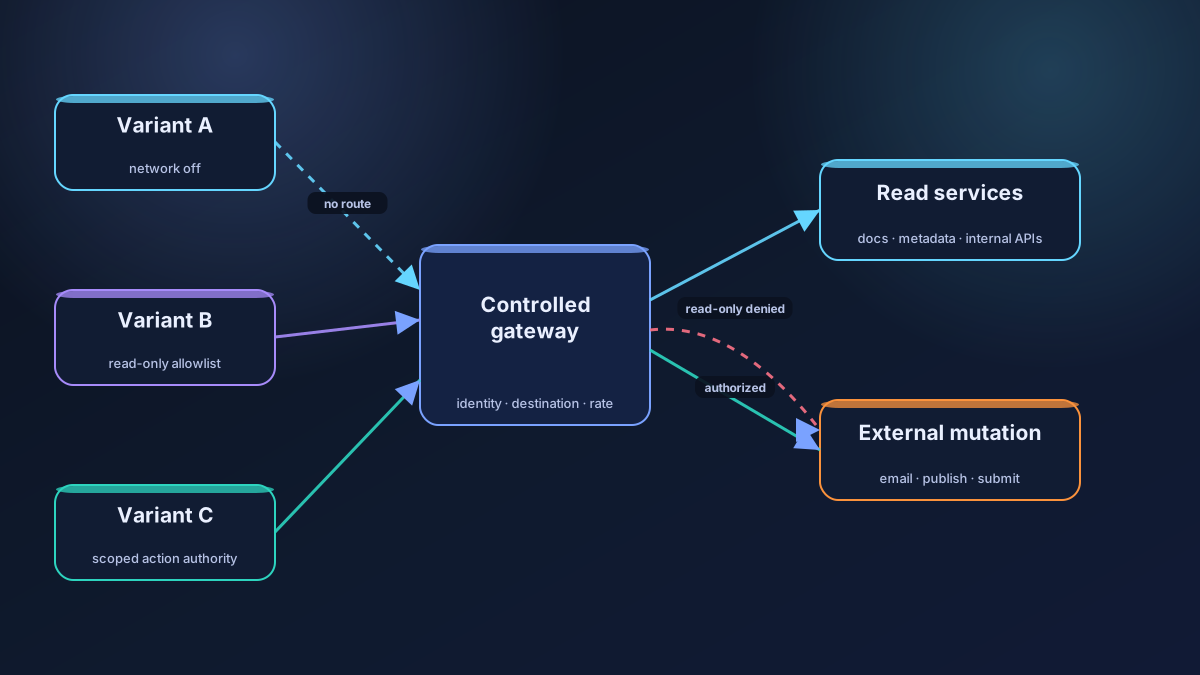
Allowing only one variant to own a real-world action can be useful when the experiment must include a live effect. Competing variants can still prepare action payloads, plans, or drafts, while one designated path performs the actual mutation. This preserves comparability without letting several experimental branches race to change the same external state.
The action boundary should remain narrow. “May use the network” is not the same as “may mutate any reachable system.” A gateway can enforce destination, method, identity, idempotency, and rate limits while keeping credentials away from ordinary workers.
Capture What Happened Without Confusing It With Value
A governed trial should leave behind enough information to reconstruct each run.
For a software task, that commonly includes:
- The baseline revision and task definition
- Model and reasoning settings
- Runtime fingerprint and reuse status
- Process identity and timing
- Standard output and standard error
- Structured result packets
- Token or provider receipts
- Changed paths and untracked files
- A complete patch against the baseline
- Runtime and environment lineage
- Cost and quota observations
- Any network or external-action receipts
These are observations. They establish what the run did. They do not, by themselves, establish that the work was useful.
That distinction is important because mechanical success is easy to overvalue. Return code zero means the process exited normally. A nonempty patch means files changed. Passing tests means the tested properties held. None of those facts alone establishes that the task was interpreted correctly, that the design is maintainable, or that the result is worth integrating.
Evaluation is better represented as a vector than one score:
V = [U, C, S, I, K, R]where:
- (U) = task utility
- (C) = correctness
- (S) = scope adherence
- (I) = integration or repair effort
- (K) = resource cost
- (R) = repeatability
Different trials can assign different priorities to those dimensions. A production bug fix may emphasize correctness and scope. A design exploration may value novelty and architectural leverage. A batch content workflow may emphasize throughput, consistency, and the cost of human correction.
The trial infrastructure should capture the facts needed for that judgment without pretending to make every semantic decision itself.
Extract Value Without Promoting the Whole World
One of the most useful properties of an isolated trial is that the environment and the result can have different fates.
The workspace may be temporary. The patch may be valuable.
For coding tasks, the trial can produce a portable diff or commit bundle. A trusted application path then applies that change against a known clean base, checks for conflicts, runs appropriate validation, creates a review branch, and records provenance. The isolated workspace can be deleted regardless of whether the change is accepted.
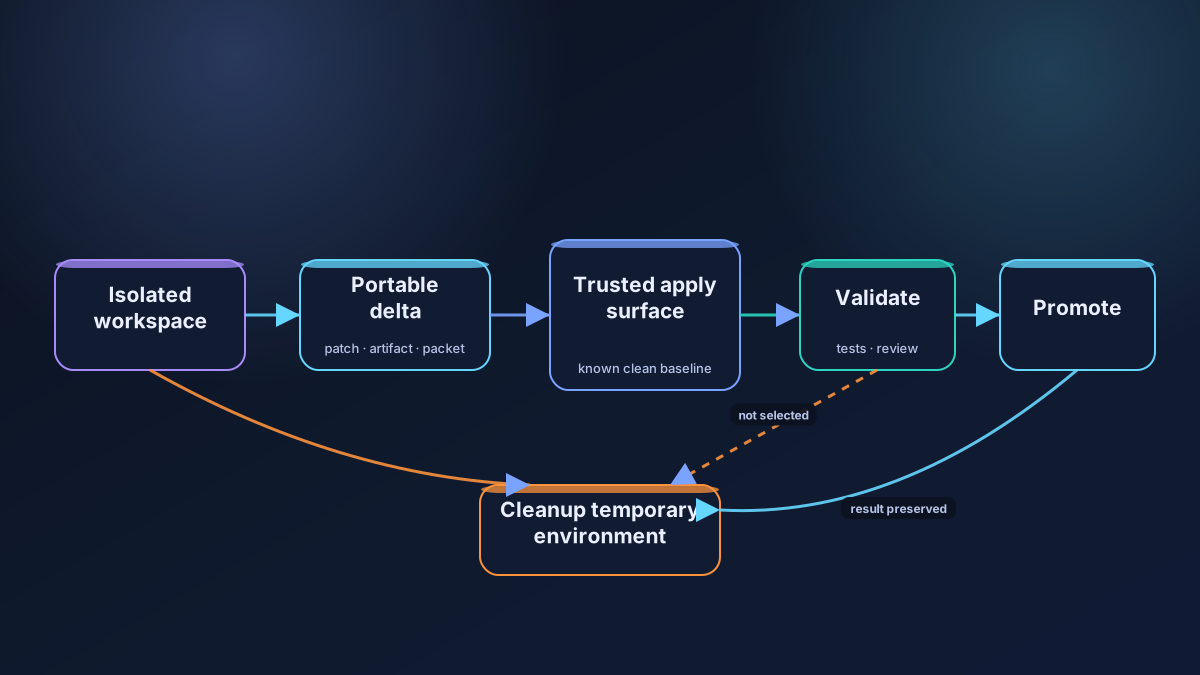
The same pattern extends beyond code:
- A research trial can export a structured recommendation and its source set.
- A browser trial can export an action plan, screenshots, and a prepared payload without retaining the session.
- A workflow trial can export a validated task graph.
- A content trial can export selected assets and metadata while discarding intermediate generations.
The architectural goal is portability of value. A useful result should cross from the experimental world into the trusted production path through an explicit interface.
Cleanup and Rollback Are Different Operations
Cleanup ends the experiment by releasing resources it owns.
Rollback restores shared reality after the experiment changed something outside its ephemeral envelope.
Those operations overlap, but they are not identical.
Cleanup may include
- Stop registered trial processes
- Observe their terminal state
- Release runtime namespaces
- Remove process registrations
- Delete variant-owned temporary directories
- Revoke temporary network or action capability
- Mark the scope ended
Rollback may additionally include
- Restore a repository or filesystem snapshot
- Restore selected durable data to a known version
- Revert an external system through a compensating action
- Restore a runtime or binary slot
- Restart affected services
- Preserve the broken state for later inspection
A well-designed system plans before it acts. The operator or controller should be able to inspect which processes will be stopped, which paths will be deleted, which namespaces will be released, and which state will be restored.
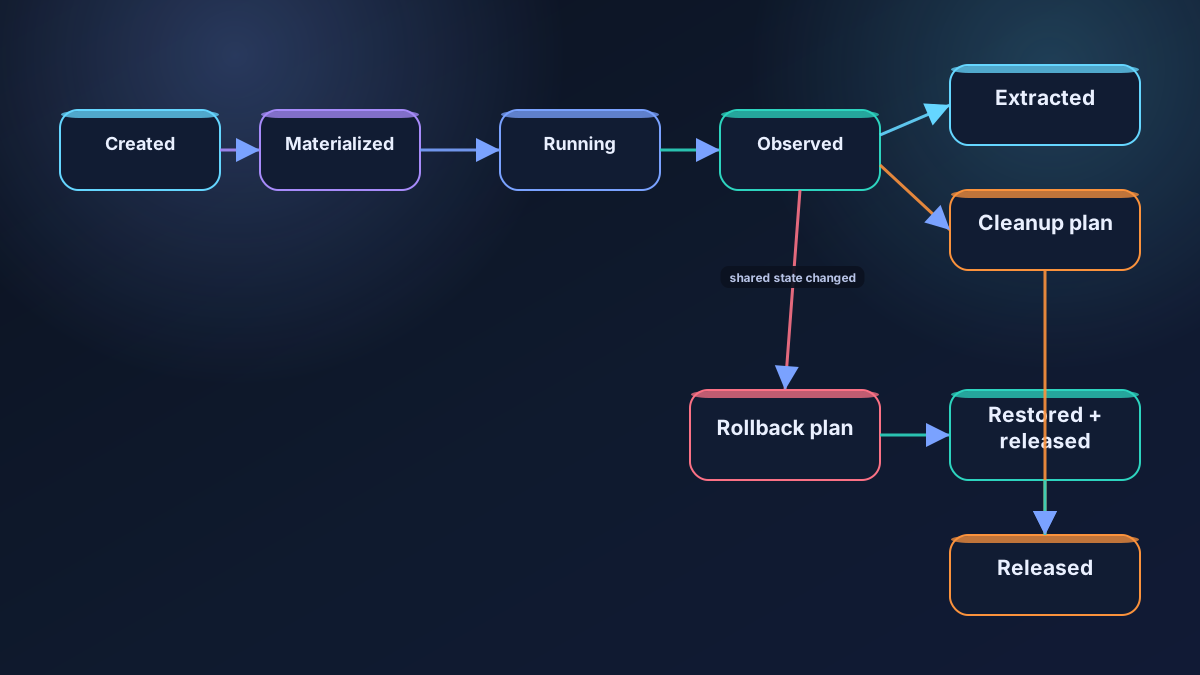
The ownership invariant remains critical. A cleanup routine should fail rather than delete a directory whose management boundary it cannot prove. A rollback routine should distinguish repository state, durable application data, running processes, and external effects rather than assuming that restoring one snapshot restores everything.
This composed model is more reliable than treating “rollback” as one monolithic command.
Operator Experience Is Part of the Architecture
A trial is not governable if understanding it requires searching raw logs across several directories.
The primary observation surface should answer, at a glance:
- What task and baseline were used?
- Which variants ran?
- Were model, reasoning, time, and budget settings comparable?
- Which workspace and runtime belonged to each variant?
- Which processes are still alive?
- What files and durable artifacts changed?
- What did the run cost?
- Were any network or external actions attempted?
- Which output is available for inspection or extraction?
- Is cleanup complete?
- Is rollback available or pending?
A compact operator view might look like this:
TRIAL: ingestion-retry-redesign
BASELINE: working tree snapshot 2026-07-15T09:30Z
STATUS: completed; cleanup pending

VARIANT A
  runtime: dependency image reuse hit
  process: exited normally
  changed: 4 files
  output: patch + implementation note
  external actions: none

VARIANT B
  runtime: dependency image reuse hit
  process: exited normally
  changed: 7 files
  output: patch + migration plan
  external actions: none

NEXT ACTIONS
  inspect both patches
  apply selected patch to clean review branch
  execute cleanup plan for both scopes
The view should be generated from structured state, not maintained as a second source of truth. Raw logs, receipts, patches, and manifests remain available underneath it for deeper investigation.
What Governed Experimentation Looks Like in Practice
Consider a team evaluating two autonomous coding strategies for a substantial ingestion refactor.
The task requires changing a parser, updating a durable state model, preserving compatibility, and adding targeted tests. It is too large for a toy benchmark and too risky to let two experimental workers edit the same live repository.
A governed experiment can proceed as follows:
- Capture a known source baseline.
- Create two owned repository workspaces from that baseline.
- Compute one dependency fingerprint and reuse the same versioned runtime image.
- Give each variant an independent mutable runtime and process identity.
- Apply the same model, reasoning, timeout, and token allowances.
- Disable external network access because the task is repository-local.
- Run both variants in parallel.
- Capture their patches, changed paths, test outputs, result packets, and usage receipts.
- Inspect the two results for correctness, scope, architecture, and integration effort.
- Apply the selected patch to a clean trusted branch and rerun validation.
- Release both trial scopes, including processes, namespaces, and temporary directories.
The team gains a real comparison on real work without accepting either experimental environment as production state.
For an operational workflow, the same architecture can permit one designated variant to perform a narrow live action while others remain in preparation or simulation mode. The experiment can compare planning and execution strategies without allowing several contenders to mutate the same external system.
This is the practical meaning of safe-to-fail autonomy: the system is free to perform substantial work because the surrounding architecture knows what belongs to the experiment, what may cross into shared reality, and how the experiment ends.
Design Principles for Governed Agent Trials
1. Compare worlds, not only outputs
Model responses are only one artifact. Preserve the state, actions, processes, cost, and changes that produced them.
2. Fix the baseline and parity contract
A fair comparison requires explicit source state, task definition, model settings, time limits, token limits, and dependency basis.
3. Isolate mutable state
Workspaces, runtime copies, process identities, temporary data, and queue ownership should not be shared accidentally across variants.
4. Reuse immutable infrastructure
Dependency-fingerprinted runtime images, cached read-only corpora, and prepared base snapshots can reduce friction without sacrificing comparability.
5. Treat networking as an independent capability
Network access, credentials, and real-world action authority should be narrower than general process execution.
6. Preserve portable outputs
A trial should produce patches, artifacts, receipts, or decision packets that can be reviewed and moved into a trusted path without promoting the whole environment.
7. Separate observation from evaluation
Exit codes, tests, token counts, and changed-file counts are facts. Usefulness, maintainability, and business value require a separate judgment.
8. Plan cleanup before executing it
Make resource effects inspectable, delete only owned paths, and preserve a clear distinction between cleanup and rollback.
9. Measure infrastructure friction
Environment creation, dependency setup, and teardown are part of the experimental system. Optimize them so realistic trials remain routine.
10. Make the end state explicit
Every trial should terminate in a known state: useful result extracted, resources released, rollback completed, or a clearly identified recovery action pending.
The Fastest Teams Will Be the Ones That Can Reverse Themselves
Autonomous systems expand what software can do without continuous human execution. They also expand the amount of mutable reality one experimental run can touch.
The answer is not to limit every experiment to a text-only sandbox. That removes much of the value being evaluated. The answer is to build infrastructure that makes substantial experiments cheap to create, realistic to run, easy to inspect, and predictable to unwind.
The most effective architecture combines:
- Real repository-specific tasks
- Owned parallel workspaces
- Reusable dependency runtimes
- Explicit process and namespace custody
- Bounded network and external-action authority
- Complete deltas and receipts
- Portable extraction of useful work
- Deterministic cleanup
- Composed rollback for shared state
That is governed experimentation for autonomous systems.
It turns “let the agent try” from an informal gamble into a repeatable engineering capability.
Compare autonomous-system variants inside governed, recoverable environments.
We can design isolated workspaces, parity contracts, resource envelopes, network authority, extraction, cleanup, and rollback for real-task agent experiments.
Related engineering notes

The Control Plane Outside the Agent
A practical architecture for operating autonomous AI systems with independent process custody, semantic health, runtime isolation, calibrated controls, and coherent rollback.
Read article →
Why Agent Traces Are Not Enough
A practical architecture for observing what autonomous systems saw, decided, delegated, spent, changed, and delivered—not merely which API calls completed.
Read article →